
Awards and Recognitions

FutureNet Asia 2026 Winner: Automation Solution Award
FutureNet Asia 2026 Winner: AI-driven Orchestration Award
FutureNet Asia 2026 Winner: Autonomous Network Operations Award
NaaS Excellence Awards 2026 Winner: Multi-Party Lifecycle Coordination Platform
IDC MarketScape 2026: Amdocs Named a Leader in Autonomous Network Operations
Addressing key challenges

Complex, hierarchical enterprise orders
Orchestrates large-scale enterprise orders comprising hundreds of site, product, and service orders with cross-order dependencies.

Hybrid and multi-system fulfillment environments
Coordinates fulfillment across BSS, OSS, inventory, activation, and third-party systems using agile interfaces.

Manual fulfillment and error-prone processes
Automates fulfillment activities while enabling guided manual tasks and ad-hoc interventions when required.

Limited visibility into fulfillment progress
Delivers end-to-end order tracking, hierarchical order views, and milestone-based progress monitoring.
Delivering Tangible Business Outcomes
1
Dramatically speeds up service design, testing, launch, and fulfillment through automated, catalog-driven, and reuse-orientated capabilities
2
Drives significant OPEX reduction through end-to-end process automation, unified platform management, and the productivity gains from GenAI-readiness
3
Provides the essential single solution to orchestrate services across converging legacy and next-generation infrastructure without costly and disruptive ‘rip and replace’ strategies
4
Enables rapid response to market changes with modular, cloud-native architecture and open, standard-based APIs
Resources
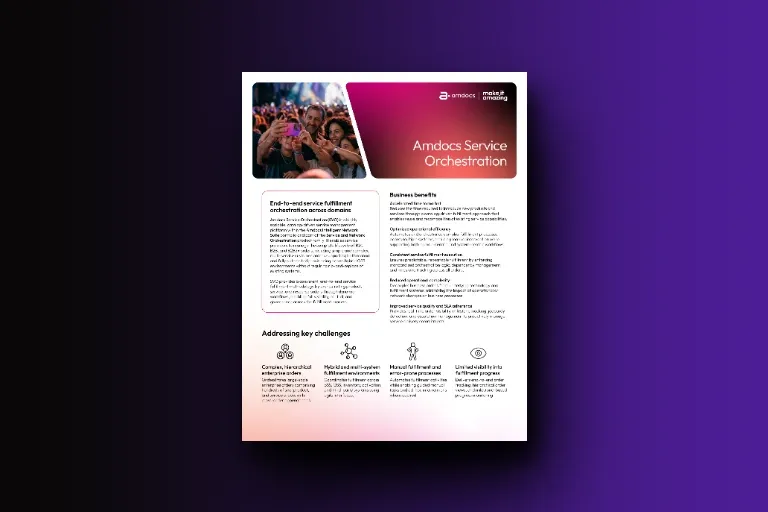
Amdocs Service Orchestration
Service Orchestration provides a consistent, end-to-end service fulfillment methodology by orchestrating product, service, and resource orders through dynamic workflows, enabling full visibility, control, and governance across the fulfillment process.
Related insights






Frequently Asked Questions(FAQs)
What is service orchestration in telecommunications?
Service orchestration is the automation and coordination of end-to-end service fulfillment processes across OSS, network and IT domains. It enables telecom operators to design, activate, deliver and manage services faster while reducing manual effort and operational complexity.
How can telecom operators automate service fulfillment across OSS and network domains?
Telecom operators can automate service fulfillment by using service orchestration platforms that coordinate workflows across OSS, network and inventory systems. By automating order decomposition, resource allocation, service activation and fulfillment tracking, operators can accelerate service delivery, reduce manual intervention and improve operational efficiency.
What is a catalog-driven service orchestration platform?
A catalog-driven service orchestration platform uses a centralized service catalog to define products, services and resources. This approach enables faster service design, consistent fulfillment processes and streamlined management of complex telecom services across multiple network domains.
What are the key capabilities of a telecom service orchestration solution?
A telecom service orchestration solution typically includes service modeling, order orchestration, service decomposition, workflow automation, inventory integration, fulfillment tracking and lifecycle management. These capabilities provide end-to-end visibility and control across the service delivery process.
How does service orchestration reduce operational complexity for telecom providers?
Service orchestration simplifies telecom operations by automating manual processes, integrating disparate systems and standardizing fulfillment workflows. This reduces operational silos, minimizes errors and enables service providers to deliver complex services more efficiently and at scale.