
Take a no-code approach to faster product development
Modernize the banking experience with tailored products
Empower business users with no-code speed
Your customers want more than one-size-fits-all products and offers. To achieve the levels of personalization customers expect, you need to free banking products from the constraints of legacy systems. You unleash true personalization by empowering the business with no-code product management and 360-degree customer views.
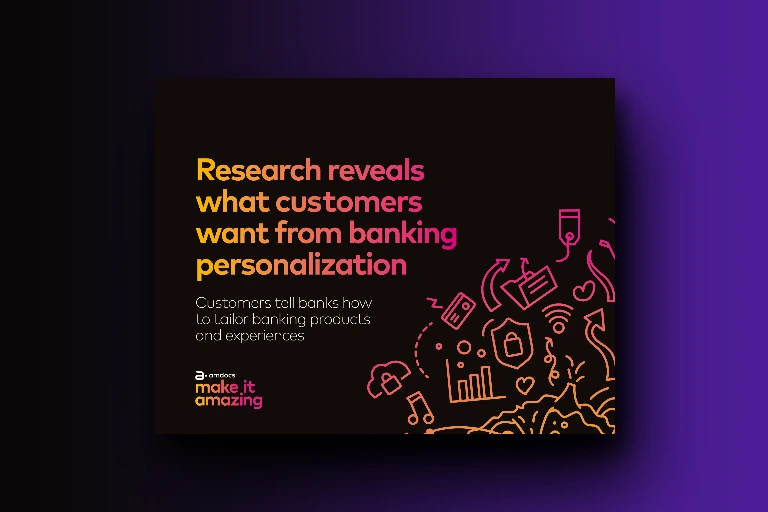
Hi. I'm Katie Peggenkoff, and I'm responsible for strategy and research delivery within our financial services practice at Amdocs Project two zero two. I work with a lot of retail bank customers, and they tell me about all of the data that they collect, and they need it for a lot of reasons. But what about if they could use it to delight their customers? We think that this is exactly the direction banking should be going, and we believe that personalization is one mechanism that banks can use to delight their customers. So what is personalization? From a practitioner's point of view, we define it as the delivery of experiences based on unique data of one individual user. That data could be transaction information, online shopping habits, or even geography. So when we talk to customers, we wanted to know, are they aware of personalized experiences? And if so, what are the boundaries between them being excited about a brand anticipating their needs versus feeling like a brand or company knows too much about them? Through generative research methods, we talk to ten users for ninety minutes each to get at this information. As professionals, we know that data privacy is a big part of deploying personalization. But what do customers understand? Well, when we talked to customers, they told us that they know that there's a lot of data fueling personalization. But they don't fully understand how much control they have over their data. And this is something that is important to customers. One respondent married with kids living in North Carolina told me quote, the amount of information banks have about me is unsettling. So what is driving this feeling of being unsettled? We discovered that there are two trends in customers' mindsets when they think through personalization. For receptive customers, they felt that personalization was a way to save money or a way to learn about the world. For example, we had one user tell us that she had purchased concert tickets and then received recommendations for restaurant venues right near the concert location. She was thrilled. The less receptive customers who have a fear response, they tend to make incorrect assumptions about how they can manage their data. These customers described hypothetical features within their banking dashboard, something similar to social media, where they believed they could go in and turn on and turn off different groups of data that their bank had access to. When conducting our analysis of what customers told us, we saw a quadrant emerging with four different mindsets. There was a scale of curiosity to paranoia that seemed to capture customers' emotional reaction and a scale of complexity, looking at transaction volume from less complex to more complex, that captured their behaviors. Let's look at these four quadrants together. Let's start in the upper right with the most curious and most complex mindset. This is who we're calling the shopper. They will go so far as to compare the offers they have to their friends. They want as many offers as they can and this is a group that skews female. So let's keep looking in the high transaction side of the quadrant. Let's go down to the commander in chief. They typically have dependents and they are short on time. This is a group that wants a single view of their entire financial ecosystem. If you're not helping them do that, you're getting in their way. The Method Man is slightly paranoid about personalization and has lower transaction volume. Without fail, the customers in this group described a really bad experience that they had had in their late teens or early 20s with banks or credit cards. They carry that into adulthood by wanting to be well educated on privacy policies and fraud monitoring. Now let's move up to the upper left quadrant to our value seekers. They are curious but have low transaction volume. This is a group that is always looking for a deal. They always want offers. But because they're looking to save money, they believe and expect personalization should be used as a reward for loyalty. Together, these four mindsets give us a starting point to establish some initial use cases and personalization. Then from here, we can design something specific, prototype it, test it, and eventually deploy to customers. Let's talk about the different types of personalization that customers describe to us during our research and the relative value that those personalization types had. The first type is offers. This is the most frequent type of personalization in the market and has the lowest value. I'm talking about balance transfers or refinance offers. Why is it considered low value? Well, customers told us that they rarely saw a connection between their own purchase history and interests and what was being offered. The exception? One customer did tell us about coupons that he received through his grocery store app. He loved it. He would receive coupons for items that he regularly shopped for at the nearby grocery store. A second type of personalization customers describe to us is info advisory. This is where companies or brands are actively pushing information that advises customers. This provides them with more value than offers, but it's still low. Essentially, info advisory is anticipating when a customer is going to need particular advice or guidance in delivering that. Now this could go too far. We did have customers describe where they were recommended a conversation with a financial advisor, which they were excited about and they had the conversation. But then after saying to the financial advisor one conversation was enough, follow ups became intrusive, and the end user felt like their privacy had been compromised. The third type of personalization is in process personalization. This is the highest value to customer and unfortunately the rarest in the market today. In process personalization helps customers through a series of experiences or a journey, and it's based on their unique data. Examples of in process personalization include robo advisors in wealth management, replacement tracker tools in credit cards, or dispute centers on platforms like PayPal. So prior to conducting a technology feasibility exercise, work with your teams to pair a mindset with a specific type of personalization. These two components will become your origin point and your first use case on the path to deploying personalization. At the end of the day, personalization is a customer experience, and it will be successful when it works to delight customers. In our research, customers told us exactly what a good experience with a bank is. They want an app that's easy to use. They want it to be easy to schedule payments. They want a bank that's great with questions and that helps them understand the terms and conditions. So to deploy a successful personalization initiative, banks can take a mindset, a type of personalization, and then apply the known principles of human centered design to get there.
Bank on personalization
Benefits of a no-code product platform
-
Refine product development without IT resources
Open up technology to users who can manage data-driven product and personalized promotions, removing the need for technical experts.
-
Increase revenues while boosting customer satisfaction
Accelerate time to market, with drag and drop functionality, to set any parameters for a product’s eligibility criteria, enabling you to respond quickly to market demands
-
Liberate product management from the core
Bypass the core to allow easier creation, launch, and administration of products.
-
Get seamless product governance
Iterate and innovate faster as you embed compliance controls into dynamic product management
Why go beyond the norm
-
Delight customers with data-driven personalization
-
Surge ahead of the pack by uncovering winning ideas
-
Create uniquely enticing product bundles and pricing
-
Use cross-bank integration to release customer-centric products faster
Related insights
Bentzi Aviv, Head of Global Fintech Solutions, Amdocs
11 Oct 2024
Celent
31 Jul 2023
Oded Shoshany, General Manager
Amdocs Financial Services
06 Apr 2023
Amdocs Financial Services
20 Jan 2023
Amdocs
31 Jan 2023
Bentzium Aviv, Customer Business Executive
Amdocs
15 Feb 2023
Katie Pagenkopf, Practice Director, Experience Strategy & Insight
Amdocs projekt202
22 Nov 2022
Amdocs Financial Services
10 Dec 2021
Learn more
Take a position in the future of finance
Make your bank’s strategy happen, with an ally who lives and breathes digital.