Why AI monetization starts with metering
AI monetization is a metering problem before it is a pricing problem. As AI moves into enterprise platforms, network APIs, edge environments and autonomous workflows, the commercial unit of value is shifting away from access and toward consumption. Where a network session or a gigabyte once defined the billable event, the equivalent unit today might be a token, an inference job, an API call, an agent action or a completed business outcome.
Value does not distribute evenly across those units. Whereas tokens and inference calls price intelligence as a commodity, measured by what the system consumed, charging for a completed business outcome prices what the customer actually received.
The shift raises a more fundamental question — whether the underlying platform can observe AI activity in real time, decide who is entitled to consume it, price it as it happens, explain the resulting charge to a customer and settle the revenue across every partner involved.
Our industry has already solved these problems at carrier scale, for voice, data, content and partner services. Now AI-native commercial models require the same capability to meter, rate, entitle and settle at volume, applied to tokens, inference calls and agent actions.
The billable unit is changing
Until recently, the billable unit in telecom was fixed and well understood — a minute of voice, a message sent, a gigabyte moved, a roaming event, a monthly subscription, with each one discrete, countable and simple to price.
AI changes what is being consumed, and with it the relationship between cost and value. A provider running AI customer support, enterprise copilots, fraud detection or edge inference carries costs tied to model usage, GPU time, orchestration, storage and partner services, which vary considerably between one request and the next. Neither flat pricing nor subscription models were designed for this kind of variability — the first obscures the cost difference between a trivial prompt and a mission-critical task, while the second has no way to distinguish lightweight usage from the high-value, high-cost work that justifies the price.
Enterprise software has already started repricing around this. Salesforce sells Agentforce through flex credits, Microsoft prices Copilot Chat by consumption, AWS charges for Bedrock inference by input and output tokens, and ServiceNow meters Now Assist operations as usage-based tokens.
For CSPs, the exposure runs wider. They are monetizing network capabilities, AI-enhanced services, edge execution and partner-built products alongside connectivity, so the monetization architecture has to move from charging for transport to charging for intelligence, context and outcomes.
The charging infrastructure AI monetization needs already exists
AI raises the complexity of real-time charging, entitlement and settlement. The event types are more varied, the commercial controls need to reach further, and the workloads themselves are unpredictable, variable in cost and frequently dependent on a partner somewhere in the chain.
Three assets stand out.
- Real-time charging at volume. Telecom charging systems authorize, meter and rate billions of events a day, at the throughput and reliability AI workloads demand and batch reconciliation was never built to provide.
- Network APIs and edge execution. An AI application running at the network edge carries different latency and bandwidth value from the same application in a distant cloud region. A provider able to meter both can price them differently, the way a 5G slice tuned for ultra-low-latency industrial AI control can carry a price for its measurable performance.
- Multi-party settlement. An enterprise AI solution routinely combines infrastructure, model access, proprietary data, application logic and channel distribution from several companies at once. B2B2X settlement was built to allocate revenue across all of them, with a record that survives an audit.
It is worth noting that network API monetization predates generative AI, and its value here is as a proven model for turning a technical capability into something metered, partner-consumable and commercially viable.
What an AI monetization platform has to do
A GPU cluster, a model library and an orchestration layer represent considerable capital expenditure. None of these, however, generate revenue until the provider can meter consumption, enforce entitlement, price the activity and settle with every party that has a claim on it.
Six capabilities bridge this gap. Most CSPs already operate versions of all six, built for network services and now needing extension to AI workloads.
- Product and offer definition: what is actually being sold, whether token packs, reserved capacity, agent subscriptions or outcome-based services, and how each is packaged for a particular customer.
- Entitlement and policy: whether this customer, team, application or agent is permitted to consume this service now, within quota, within budget and within the rules of its jurisdiction.
- Event ingestion and mediation: converting activity from model gateways, APIs, orchestration systems, edge nodes and partner platforms into structured usage records the charging layer can act on.
- Charging and commercial decisioning: applying price and policy as consumption happens, across dimensions including token volume, model tier, latency class, workload context and partner dependency. Enterprise contracts increasingly need SLA-sensitive, context-aware pricing that static charging cannot produce.
- Billing and settlement: converged invoices, charge explanation, dispute handling, tax treatment, and revenue allocated across every partner in the chain with an audit trail behind it.
- Analytics and feedback: anomaly detection, bill-shock prevention, margin analysis and forecasting, feeding back into how the next round of pricing gets designed.
Visibility is the first priority in building them out, without which entitlement and policy has nothing to enforce, charging has nothing to rate, and analytics has nothing to learn from. Ownership is the harder part to arrange, because responsibility spans product, technology, finance, operations and partner management, with no single function accountable for all of it. A platform built with monetization at its core can price services a retrofitted one simply cannot reach, making this an architecture decision before it becomes a commercial one.
Choosing what to charge for
The unit a provider charges for shapes everything downstream, from how the invoice reads to whether the customer believes it. Enterprise buyers have started calling this design discipline tokenomics, a term that borrows nothing from cryptocurrency beyond the word itself. A poor choice produces bills the customer cannot interpret. With AI services, this loss of trust arrives faster than in almost any other category, because there is no intuition for what a reasonable number looks like.
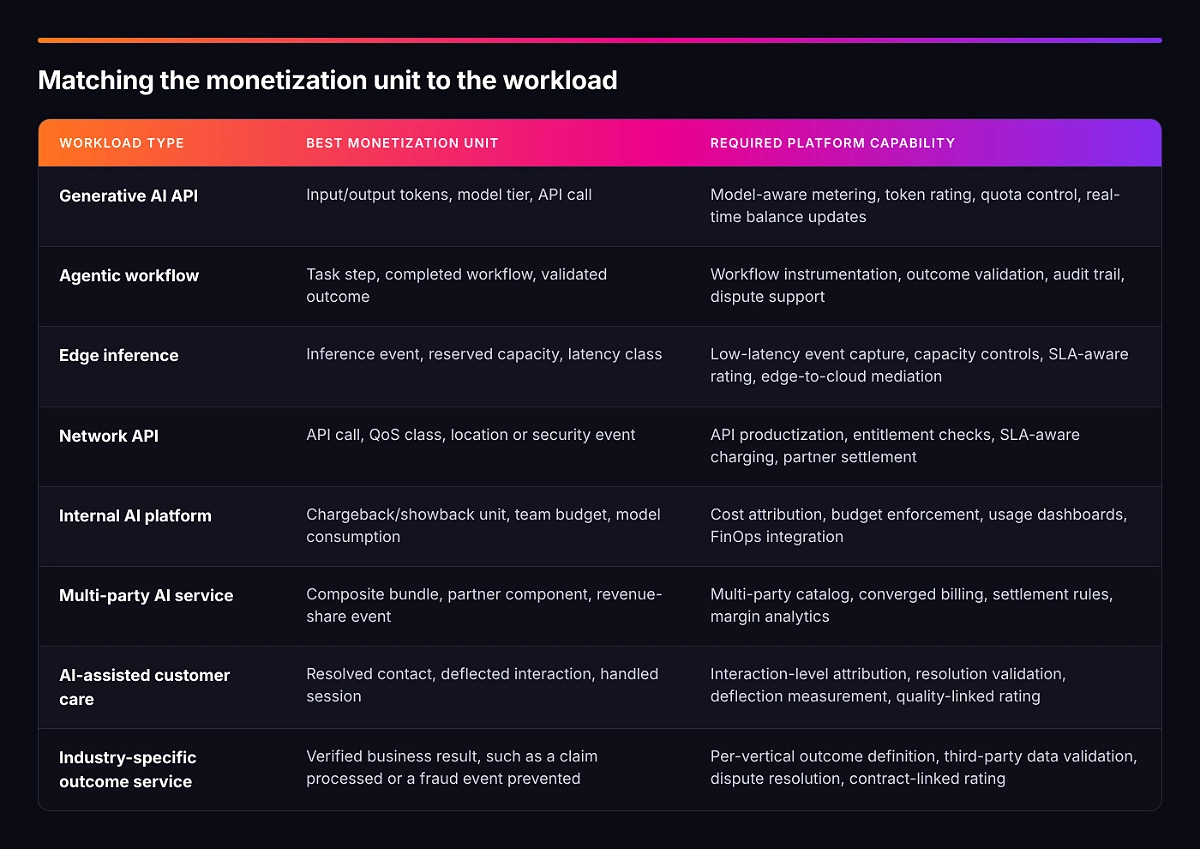
Most patterns now in use are resource-based, counting what the system consumed. Input and output tokens or a flat fee per inference track provider cost closely, though they tell the customer little about what they actually received.
Outcome-based pricing counts the result the customer received. A resolved case, a processed claim or a prevented fraud event aligns the bill with value the customer can see directly, which is where the commercial upside sits. It also carries a requirement most platforms cannot yet meet. The outcome has to be defined precisely enough to measure, instrumented across whatever systems produce it, and validated in a way that survives the customer disputing it.
Packaging applies to either model, whether pooled credits bought in advance for predictability or a subscription that carries usage charges above an agreed threshold. Service level runs as a modifier throughout, since a low-latency response costs more to produce and can reasonably carry a higher price.
In practice, most providers will adopt a hybrid arrangement with baseline access, a pooled allowance and premium rates for advanced models, low-latency execution or validated outcomes.
The workload itself usually indicates the unit.
Where token pricing goes wrong
Token models fail commercially when customers cannot interpret what they have been charged for. Opaque pricing produces disputed invoices, unexpected costs and, eventually, a reluctance to consume more.
The solution lies in how the unit is defined rather than the platform's technical capability. A unit of AI service should be something the customer can picture. One short answer from a model, or one minute of high-priority processing time, gives a buyer something to reason about in a way a raw token count never will. For example, while an invoice showing cost per issue resolved by an AI agent tells a customer what they bought, four million tokens itemized across a billing period tells them almost nothing, even when both describe identical consumption and reach the same total.
CSPs face the equivalent problem in reverse. Cloud model pricing and GPU costs can be sharply variable. A formula built against last quarter's rates can quietly stop covering them. Dynamic cost monitoring and margin analytics are what expose the shortfall before it accumulates across a billing period.
Real-time observability, policy enforcement, anomaly detection, charge explain ability and auditable allocation address both sides simultaneously, which is why the monetization platform functions as a governance layer as much as a commercial one.
Where infrastructure meets monetization
Building and monetizing AI require capabilities that rarely sit in the same organization. The infrastructure side — GPUs, models, orchestration — is a different engineering discipline from the rating, entitlement, settlement and billing systems that generate the revenue. Most companies have one or the other.
Where the AI platform goes in first and the commercial model is designed afterward, the monetization layer inherits infrastructure that was never instrumented to support it. The gap surfaces at the point a provider tries to price something.
When Amdocs built AI Factory, rating, charging and metering went into the architecture alongside the compute and the models. The monetization layer was part of the original design.
Our recent collaboration with AWS connects AI Factory infrastructure to Amdocs Cognitive Core and the Amdocs Monetization Suite. Providers can then offer GPU infrastructure and AI services on commercial terms they define themselves.
Designing for pricing that will change
The market has yet to establish what AI consumption is worth. The units, thresholds and packaging being designed today across enterprise software and telecom are early attempts at pricing something the industry has very little experience of. Many will need revision once real consumption patterns emerge.
The relevant question is how quickly a provider can revise them. Units cannot be redefined without the metering to support them, thresholds cannot be moved without entitlement controls to enforce them, and an outcome-based model is only as credible as the mechanism that validates the outcome.
The providers who do well here will be those who can afford to be wrong early and correct quickly, which in a category still forming is worth considerably more than the accuracy of any first attempt.