eSIM Entitlement Server Trusted by Leading Mobile Operators
Accelerate device onboarding, simplify entitlement management, and reduce reliance on lengthy vendor development cycles. Explore the advantages for both business and platform teams and see why leading operators have deployed the platform in production.
- Every device launch — phones, smartwatches, IoT — requires ES certification and custom development.
- Every new service — silent authentication, satellite, 5G SA — is a 12–18 month vendor project.
- The vendor contract is one line item. The true cost — custom development, staff, and overhead per release — never appears on it.
- On-prem ES capacity is fixed at build — sized for a peak load that may never arrive, and unable to flex when it does.
- Security patching, vulnerability management, compliance — on an on-prem system, the risk register belongs to your team.
- On-prem is engineered for peak, staffed for peak, and costs peak — whether the business demands it or not.




#1 eSIM ES & Orchestration — 2025 independent ranking. 12,000 Scales up and down on demand. Multi-zone, multi-region, active-active. Up to 20% Verified in a live Tier-1 migration. Faster velocity, engineering teams refocused on product development. Tier-1 chosen The largest North American operator chose Amdocs's managed SaaS over the incumbent network-equipment vendor. All scales Same platform, same SLA across the full subscriber range.
Counterpoint Pacesetter
TPS - elastic capacity on Azure
TCO reduction - and a transformed operating model
Managed SaaS at hyperscale
Small MVNOs to hyperscale Tier-1
See the operational savings and potential new-service revenue created by migrating from an aging on-premises platform to Amdocs Cloud Entitlement SaaS.
The figures shown are indicative estimates only and do not represent a guarantee of actual results. Outcomes may vary based on real-world conditions.
Move from legacy on-prem to
modern Entitlement Server as a Service
from custom development per release to out-of-the-box OEM delivery.
On-prem - custom development per release
An OEM releases a device or service
A vendor project begins — scoped, quoted, and contracted over 12–18 months before anything reaches the market.
12–18 months
Change request and custom development
Every device certification and service launch requires bespoke engineering. $1–2M+ per cycle.
$1–2M+ per release
Product roadmap held hostage
Development is always behind what the business wants to launch. Devices and services queue behind vendor cycles.
Stifled velocity
Security is your team's problem
On-prem patching, vulnerability management, and compliance are operator-owned. The risk sits with you.
Operator-owned risk
Fixed capacity — engineered and staffed for peak
Large operator team. Infrastructure sized for maximum load. Overhead, regardless of actual demand.
Fixed overhead
Amdocs ES - out-of-the-box OEM delivery
An OEM releases a device or service
Pre-certified and live the same day — no vendor project, no change request.
Day zero
Out-of-the-box — no custom development
Every Apple and Android release built into the platform. New services available without a project.
No change request
Product roadmap moves at business speed
The ES is no longer the bottleneck. Devices and services launch when the business is ready.
Business velocity
Security managed by Amdocs
Cloud-native architecture. We take responsibility for security, patching, and compliance. Your team is freed for product work and service development.
Managed & secured
Elastic cloud capacity — fully managed
Scales with demand. No operator staff overhead. Amdocs operates it end-to-end.
Elastic & managed
Device and service velocity
Every new device requires ES certification. Every new service — silent authentication, satellite, 5G SA — requires a vendor project: scoped, quoted, and 12–18 months to market. The ES sets the pace of the business roadmap.
Amdocs ES: OEM-native pre-certification for Apple and Android. Every device and service available immediately — no change request, no project, no delay.
Platform reliability, scale, and security
On-prem systems are engineered for peak capacity — and maintained by a large operator team. Security patching, release management, and certification consume the platform team's time and bandwidth.
Elastic cloud capacity. Amdocs manages reliability, security, and scale. Operator team freed for product work and service development.
The true cost of how you work today
The contract is one line item. The custom development per device, per service, per release cycle — and the large team required to manage it — is the real cost. Most operators have never run the full cost model.
Up to 20% TCO reduction over 5 years, verified in a live Tier-1 migration. Calculate your ROI projection — it takes two minutes.
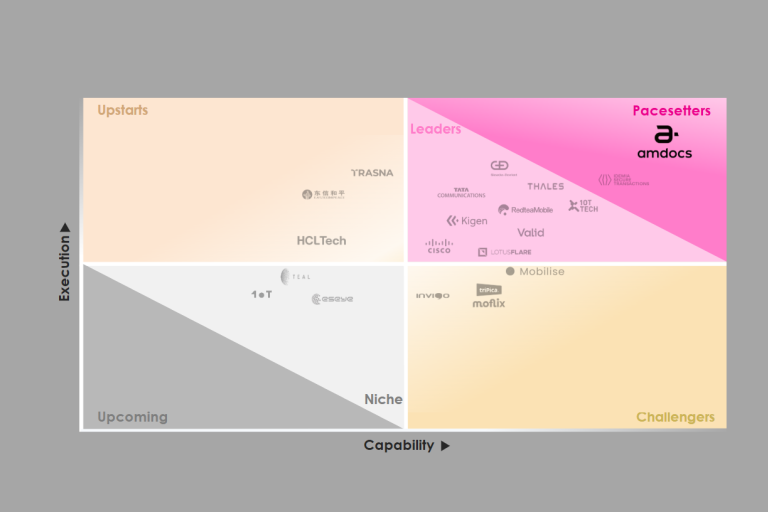
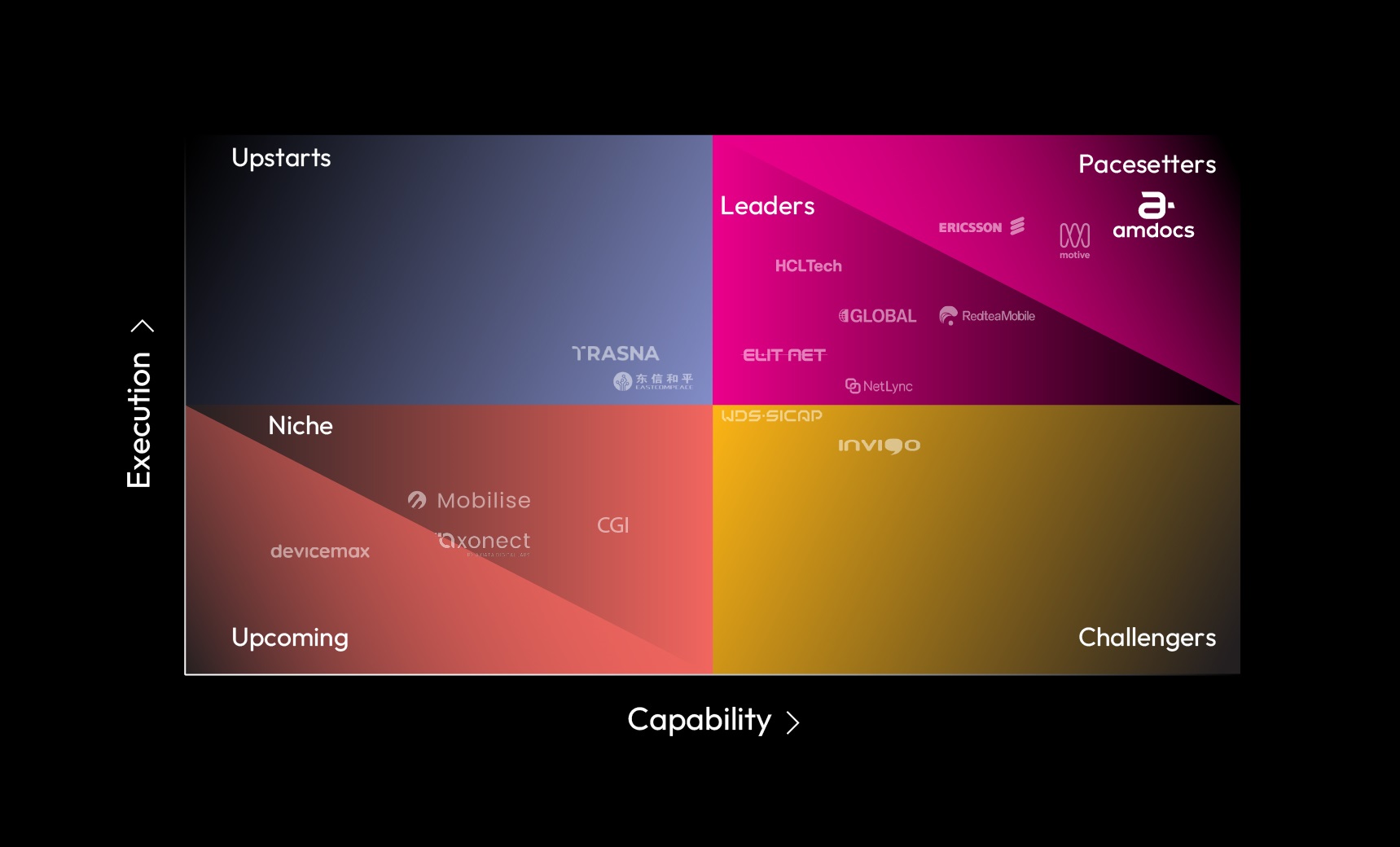
Amdocs ranked #1 Pacesetter in both ES and Orchestration
Counterpoint's Global Entitlement Server CORE Rankings 2025 places Amdocs at the top of both categories, above all incumbents and challengers on both capability and execution.
Modern Entitlement Servers
Flexible, Scalable, Future-Ready. Why cloud-native is becoming table stakes for great CX, fast monetization, and multi-device scale.
Frequently Asked Questions
Why do mobile operators need an entitlement server?
Device makers including Apple and Google require an entitlement server before operators can switch on advanced eSIM features and services such as eSIM transfer, cross-platform RCS, Wi-Fi Calling, satellite, and 5G. With Apple moving newer iPhones to eSIM-only, operators on legacy or network-linked servers cannot provision these services in real time at scale.
Which vendor is ranked #1 for eSIM Entitlement Server?
Amdocs is the #1 Pacesetter in Counterpoint Research’s Global Entitlement Server CORE analysis (2025), named the top player across most platform-capability parameters. It ranks first on capabilities including platform features, security, integration, automation, and multi-tenancy, and is the only vendor positioned at the top in both Entitlement Server and Orchestration.
What’s the difference between a cloud-native and an on-premises entitlement server?
A cloud-native entitlement server delivers new device and OEM features out of the box with automated, low-downtime updates, and shifts cost from CapEx to OpEx. Legacy on-premises systems run on change-request-driven cycles, where each OEM update needs custom integration — slowing time-to-market, capping scale at fixed hardware, and raising total cost of ownership.
How long does it take to launch a new device or service on an entitlement server?
On a legacy on-premises entitlement server, each new device or service is a vendor project that is scoped, quoted, and contracted — commonly 12–18 months to market at $1–2M+ per cycle. With Amdocs, Apple and Android releases are pre-integrated and available on day zero, with no change request or project.
What is the true cost of an on-premises entitlement server?
The vendor contract is only one line item. The real cost of an on-premises entitlement server is the custom development per device and per service, plus the large team needed to run, patch, and scale it. Amdocs delivers up to a 20% TCO reduction over five years, verified in a live Tier-1 migration.
What’s the difference between eSIM Orchestration and an entitlement server?
eSIM Orchestration connects operators to profile manufacturers and manages the eSIM profile lifecycle. The entitlement server authorizes advanced device features and services such as eSIM transfer, watch pairing, VoWi-Fi, and 5G. Amdocs is among a small set of vendors offering both as a tightly integrated platform, and Counterpoint ranks it at the top in this combined capability.
Does the Amdocs Entitlement Server support Apple and Android?
Yes. The Amdocs Entitlement Server supports both iOS and Android, aligning with GSMA standards (TS.43, SGP.32) and OEM frameworks including Apple’s, and integrates with Google’s Android Configuration Server (ACS) for RCS, VoIP, and Wi-Fi Calling. New OEM releases are built into the platform, so operators adopt them without a separate integration project.
Who is responsible for security with a SaaS Entitlement Server?
With Amdocs’s managed Entitlement Server as a Service, Amdocs is responsible for security, patching, and compliance, with built-in protection against eSIM fraud and SIM-swap attacks. The cloud-native architecture removes the internet exposure of on-premises systems, where vulnerability management and compliance otherwise remain the operator’s own risk.