Who answers for what your AI decides? The trust engineer
As AI becomes more autonomous, the Trust Engineer is emerging as the professional responsible for ensuring AI decisions are trustworthy through governance, validation, explainability, and accountability.

Traditionally, the only real software quality gate sat at the very end, right before release. Then, as DevOps took hold, it moved left, into testing earlier, CI/CD pipelines, and developer workflows. It brought faster feedback, earlier defect detection, and higher release velocity.
But these practices were built for deterministic systems — software that executes predefined logic and produces predictable outputs. AI systems, in contrast, are non-deterministic, meaning they make autonomous decisions, adapt their behavior based on context, and generate outputs that were never fully predefined. At a certain point, linear, deterministic assurance models can no longer keep pace with systems that make their own decisions and follow paths that were never fully anticipated. We call this moment the Quality Breakpoint.
Past this point, confidence matters more than features. Confidence means knowing the system will behave correctly under real-world conditions. This means decision accuracy, data integrity, security, and explainability all require baselines, thresholds, and continuous monitoring across the full system lifecycle. It’s a shift from “does it work?” to “will it hold up under real-world uncertainty, over time?”
From quality engineering to trust engineering
At Amdocs, we talk a lot about building systems that operate at scale, under constant change and across highly complex environments. In this reality, trust has to be designed, measured, and constantly validated. Organizations that assume this will emerge from good engineering alone are taking a risk the data does not support. Indeed, according to the Quality Times Vol. 2 by Amdocs, 73% of QE leaders cite limited visibility into AI decision-making as their top barrier to trust. It’s also where we defined trust in the agentic era as “the ability to defend and justify AI behavior under scrutiny as systems adapt in production.” To own that, we introduced a new role: the trust engineer.
A trust engineer is accountable for that defense, from design through deployment and beyond. Their mission is to design measures that continuously improve the Trust Index, and critically, defining what that index looks like is itself part of the job. Every organization must build its own benchmarks, calibrate them to its own risk tolerance, and monitor them as the system changes.
What the trust engineer actually owns
While the trust engineer grew out of quality engineering, it’s a distinct role. Four core responsibilities define what this means in practice.
- Setting the standard for trust: The trust engineer defines the structure of decision accuracy, explainability, compliance, data integrity and security benchmarks for the organization, sets acceptable thresholds based on the risk associated with each system being tested, and monitors the Trust Index continuously as systems change.
- Designing validation strategies: Test coverage is no longer enough. Every organization needs a playbook that defines what “good” looks like in AI systems, one that accounts for real-world scenarios, cyber threats, and edge cases like missing data or unreliable contractor input.
- Interpreting failure: In complex systems, failure is a signal worth reading closely. Whether it’s data drift, a workflow orchestration gap or a prompt issue in an AI-driven flow, the trust engineer needs to be able to determine why a specific decision resulted in a failure and what that means for the system as a whole.
- Closing the loop: What gets learned has to get back into the system. The trust engineer closes the loop by feeding what was learned back into data pipelines, workflows, and agent design.
A shift in mindset
As systems grow more complex and the cost of failure becomes more consequential, the distinction between ensuring quality and establishing trust becomes impossible to ignore. And while quality engineers still verify that systems work as intended, their focus remains largely on efficiency and early defect prevention. A trust engineer operates differently, focusing less on whether a system does what it was built to do and more on whether it can be held accountable for what it actually does. Every failure is a signal worth decoding, and so is a drift in behavior, before it becomes tomorrow’s failure.
The distinction comes down to this:
- Test and quality engineers make sure systems work.
- Trust engineers make sure they can be relied on.
Ownership, on your terms
As AI systems take on more autonomous, consequential decisions, the Quality Breakpoint becomes the permanent challenge under which organizations operate. The evidence you need to defend an AI decision has to exist before a regulator, an auditor, or a customer asks for it. Create the role now and you build it while systems are still being designed. Wait, and the answer arrives after the judgment has been made.
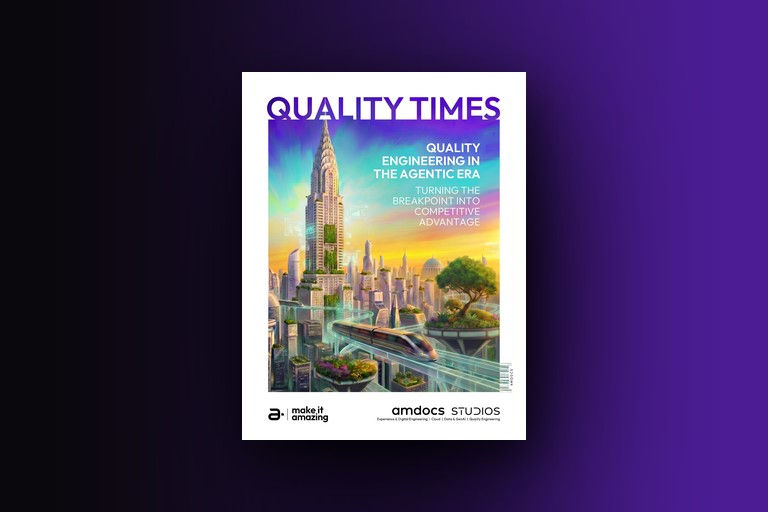
Want to explore the Trust Engineer role in more detail? Download our Quality Times 2026 eBook for deeper insights into the future of AI quality, governance, and trust.
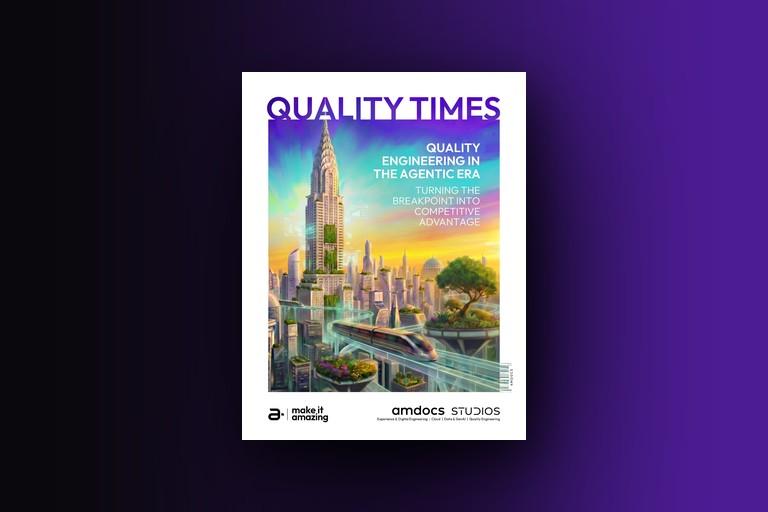
Crossing the Quality Engineering Breakpoint
Why traditional Quality Engineering cannot keep up with agentic AI, and how leaders are rebuilding quality for autonomous systems.