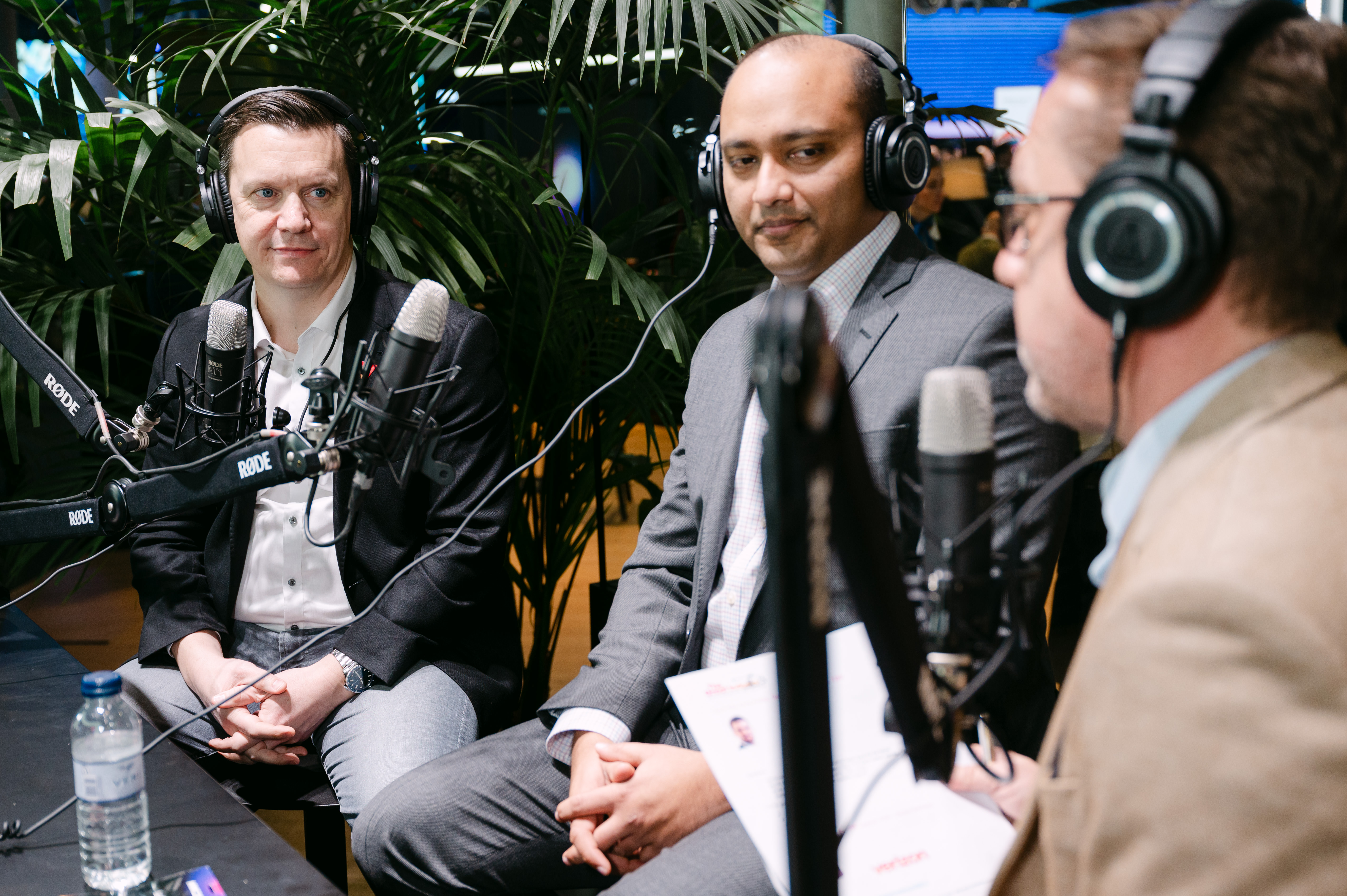
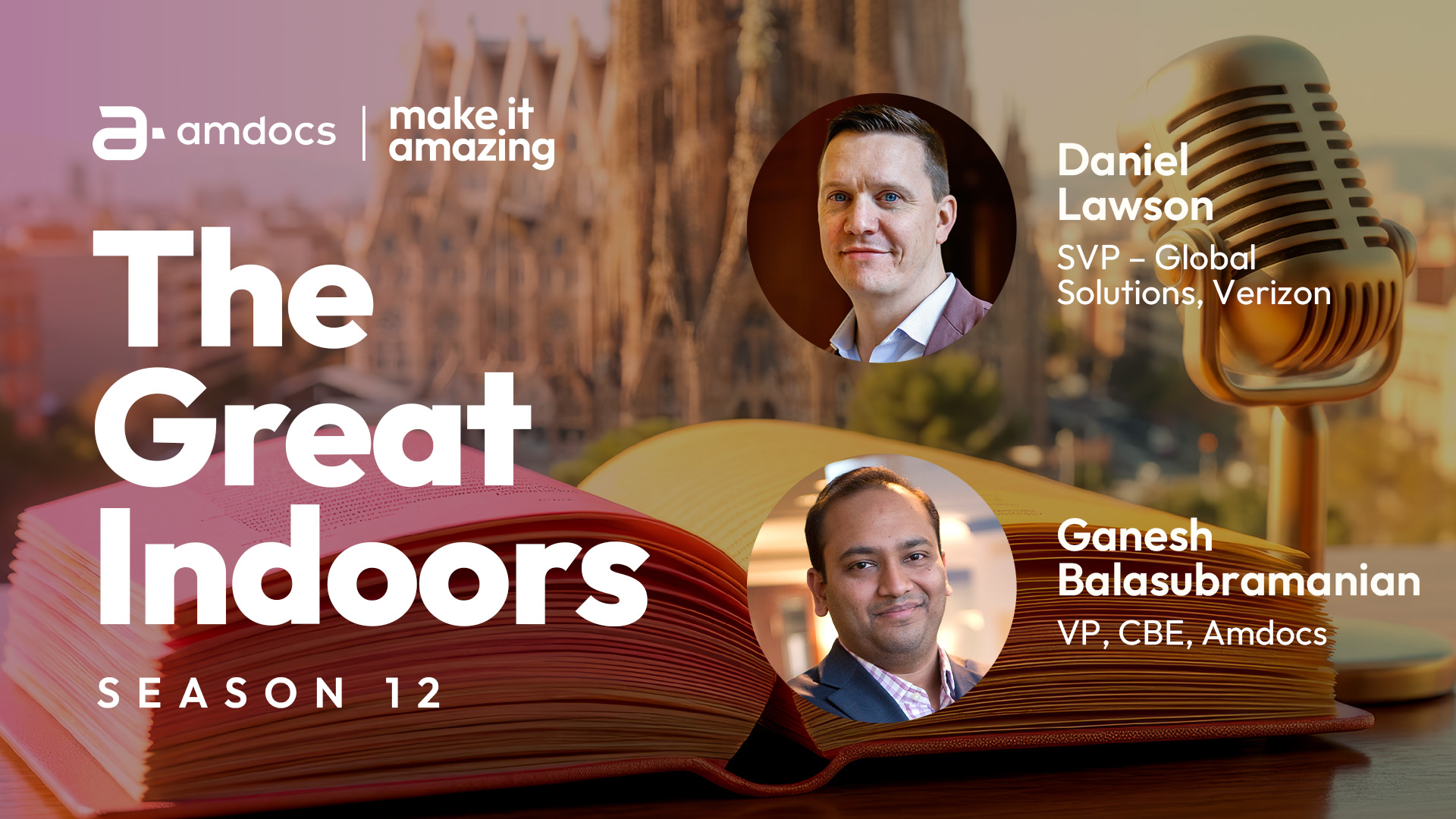
So we are back. MWC 2026. This is The Great Indoors recording season 12 live at the biggest technology show on the planet. And I'm really excited to welcome our next guest. His name is mister Daniel Lawson, the SVP of Global Solutions at Verizon. Welcome, Daniel. Thanks. Happy to be here and looking forward to a great conversation. Continue some of the energy that we see here on the floor. Wonderful. And joining me as a cohost for this first time on the podcast, Ganesh from Amdocs. How are doing, Ganesh? Doing good. Thanks for having having me. Okay. Let's get into it. I think the first thing is just for our listeners, Daniel. Give us a quick introduction of yourself, your history, and and what you do at Verizon. Sure. So for those of you who may not know, Verizon business is a business unit within the broader Verizon and covers all of our B2B business. And so global enterprise, public sector, small media business, as well as our wholesale channel. My organization, Global Solutions, we really all of the technology expertise that align to our customers globally and try to help them solve problems. Yeah. As well as some of the things we do in professional services, some more industry expertise. And so really a group of professionals that is really about problem solving. Right? Talking to our customers and understanding how we can help use our technology to help them operate more efficiently, scale, you know, be more secure in those types of things. Perfectly. And how long have you been at Verizon? You know, hard to believe, but June will be twenty 5 years from here. Wow. I've I've done I feel like almost every job in BBG or supported every type of customer, I should say, from the smallest to the to the largest, the most simple and straightforward to the most complex. So it's been a lot of fun. Cool. Great. And then I just give our listeners a quick brief on your role. Sure. So I think I I work with our North American operator customers. I've been a year in Amdocs. I have, like, about twenty years in the telecom industry. When I worked with Verizon in the past, it's great to again having on the show, Daniel. I love the way you phrased your role and your team problem solvers. That's a great way to do, you know, how Verizon helps get customers. Yep. Yep. We also use the phrase dot connectors, which obviously is a good analog to to connectivity. I like it. I like it. Now, we're on day three of the show. Yep. I'm sure you've done at least twenty five thousand steps a day and you may have seen a lot of stuff. Now normally when we come out of this show, there's an underlying theme. There's some commonalities that we see. What is it you've seen so far that surprised you, amazed you or or what do you see as some of the those themes that have come together? You know what? At a high level, think one thing that I've really noticed is the sort of the confluence of events on the timeline that we're in right now with AI, with 5G, with edge, with sensorization of cameras. A lot of the things that we've talked about in concept over the last three to 5 years are now actually starting to hit, you know, the factory floor or, you know, the the the real world. And so you're starting to see that translation between theoretical AI and physical AI. And so to to say what amazed me, actually, there's a couple of things. One was speaking to a a surgeon yesterday and talking about how they're leveraging private 5G as well as imaging to create a three-dimensional superimposed view over a surgical patient. And how that's generating so much better surgical outcomes and also better doctor experience as well. So, like, real world examples of how this is coming to fruition and generating real value. Yeah. And on a human scale, not just on a P and L scale. Right? So, like, amazing amazing thing that's happening. And I you see this across the healthcare industry. There's so many clinicians that are involved in the technology and making sure that it's fit for purpose and actually making things better. Yeah. So that's that's just been really really amazing to see. And then, you know, the other thing, you just can't walk fifty meters here without seeing robotics. Yeah. Some sort of thing. Right? Exactly. So, like, again, you're at this confluence of events that is is just startling to see how much has changed in the last twelve months, but also how much will change in the next twelve. And I think that's it, you know. For as long as we've been doing this podcast, we've speculated, we've prophesied, we've imagined some of the things that like you said, that confluence of technology could bring. And now it seems to be here. Yep. And I think that's a that's a that's a beautiful thing. And then, you know, speaking with Don McGuire from Qualcomm two days ago, he said that one of the things that they're looking at with six g when you bring in the physical AI into wearables is glasses. So he was wearing the Ray Ban glasses which I've seen so many people wearing at the show. But he said the technology will be then you will buy glasses and you will not need them to be customized for your prescription. They will alter to your eye ability. And I was like, wow. Know, so just just just overlaying the healthcare. Right. And as someone who's worn corrective lenses most of my life, that's a That's amazing. That's an amazing change. Yeah. Exactly. What the biggest thing I've seen in the show is the use cases that are evolving and no longer technology. It says that, you know, select you are working or select industries are working. Right? It's the common man use cases. There's a there's a booth there that's showing AI for restaurants. Right. Right? Right. You can talk about robotics that are far in the future, but stuff that now is is already happening and it's it's more closer to the common man than it was ever before. Right. And and it's So taking that AI and taking specifically the areas that you look at, Daniel, in in in B2B. How do you scale that for enterprise now? How do you package that up? What's the platform strategy that you need? Because we can see demos.