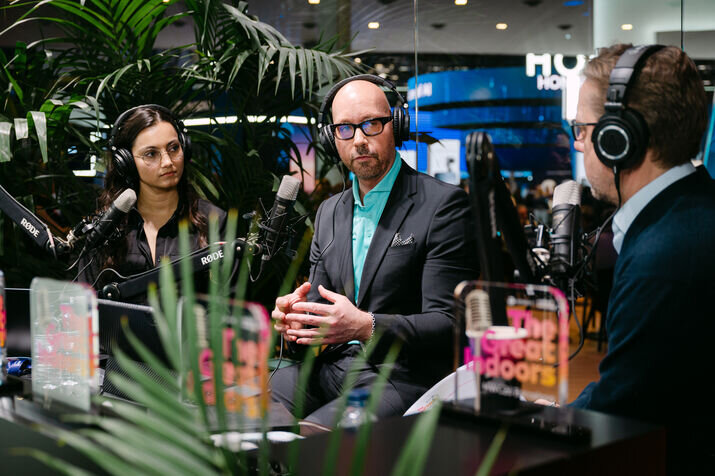
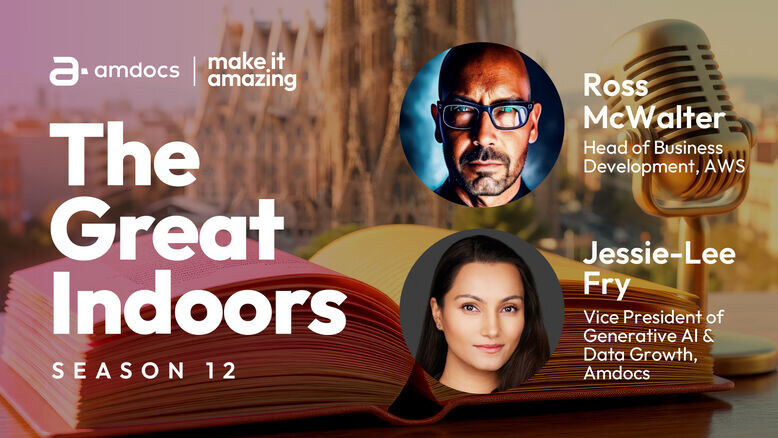
So welcome back. The Great Indoors is here, MWC 2026 live in Barcelona. We continue season twelve and and my guest right now, I'm really proud, excited to welcome to the show, mister Ross MacWalter, head of business development at AWS. Welcome, Ross. Great. Great to be here. Thank you. And also, who's gonna be helping me out is almost a cohost here. Love that. New to Amdocs. Yeah. Relatively new. So I'm I'm pleased to welcome, Jesse Lee Fry, who's VP of business development. Business, so generative AI and data growth and go to market. There you go. There you go. Try to say that five times fast. There you go. Now, cool. So welcome, Big Titan. Thank you. Yeah. So thank you for joining both of you. It's early in the morning and we're kicking it off here. So thank you for joining. And before we get going into the most substantive questions, Ross, maybe you just want to give an introduction of yourself, your history, your role, just for our listeners. Yeah. Absolutely. Thank you. So I'm with aOS. I'm part of our telco industry business unit. So we serve telcos worldwide and within that I lead customer experience for to market for customer experience. So that means anything related to how customers or enterprise interact with the brand. And that covers contact center, omnichannel, cross sell, upsell, retention, those kind of things. Perfect. Perfect. I'm Jessie. And I'm Jessie Fry. I'm the VP of generative AI and data growth and go to market at go at Amdocs. And my role is really to be at the the center between product, partnerships, and customers, and really helping kind of bring to market joint motions and articulating a product vision in a way that's tangible for our customers. Cool. Great. And you're both based in Seattle. Yes. That's great. And look, let's get dive into it. Now, the let's start with trends and and general market trends or things that you're seeing right now. Not a day goes by in any walk of life where we don't talk about AI. Right. Ross, from your perspective, what are the latest trends you're seeing as far as how it impacts the telecom industry right now? Yeah. So obviously, the term du jour, as it's been for a while now, is AI, generative AI. And I think AI and customer experience in general has really been a focus area because it's really been delivering value. And that's super important. So if you speak to telco executives, they'll tell you that, you know, about ninety percent of them are saying that it's actually increased revenues and it's actually impacted their costs. Right? So profit margins are increasing. Yeah. And about eighty nine percent of them are actually saying that they are continuing to increase investment in AI. So that means it's starting to deliver value. So they're observing value in customer experience across the contact center, across billing as well, as well as general public customer service type use cases. I think though that what we are seeing though is a degree of fragmentation in that we're seeing point AI solutions in customer care, in billing, in network, but they're not really converging into a kind of holistic AI strategy across the organization, which we tend to call the agent operating system. And that's really when AI is not just like a bolt on solution. It's something that is the primary modality that AI has delivered across the organization. So it's integrated into everything right across the value chain. So we, at AWS, help enable that agentic operating system through bedrock agent core, which is our capability there. It's just really these core primitives that enable the building scaling of applications moving from POC into production seamlessly. And then we've got these components we're gonna talk about today about in sovereign AI. So how do we enable that capability Yeah. Where the data resides, you know, latency, the physical location of the assets. And then how do we kind of impact enterprise b to b as well. Right? Because that's a key growth area for telcos given that the consumer side is somewhat stagnant. There's a key focus on enterprise b to b. Okay. That's cool. Is there anything you'd like to add to that, Jesse? Yeah. I think definitely building on the points that Ross has made. Right? I think the biggest potential, I think, jumping into, you know, because you touched on the the industry trends, but at least you also touched on the industry trends in the context of what's not working. And I think really translating, going from POC to full fledged production at scale across your entire enterprise ecosystem is fundamentally where I think we're seeing a bit of a gap in in at least the telco. And I think it's not just telco. I think it's across the industry. Right? Productionizing and monetizing AI is difficult Yeah. Because AI is evolving so quickly. Now I think there are a few key factors that contribute to that. There is the fragmented and siloed set of applications and environments that the customers have across their enterprises. And then the high integration cost associated with that transformation. Right? And the complexity, because now you're not just looking at modernizing, but you're also looking at evolving it further and trying to make whatever you are unifying future proof. Yeah. And in order to ensure that you have enterprise grade security, reliability, observability, so that whatever you implement is able to be monitored and scaled or downgraded when needed if it's not performing as expected. Right? I think also the other aspect that we need to be mindful of is the skill gap. Right? AI is evolving continuously. You know, Ross and I have worked together in the past at AWS. And I think what's interesting is we've been predominantly in the AI space. Right? But we forget that not everybody has been. Yeah. Of course. Yeah. And just the transition from pure AI to generative AI was so fundamentally difficult, even for me to kind of get, you know, put my get my head around. I can't even imagine what it feels like for somebody who doesn't work in the AI space. Yeah. Does that make sense? No. It does. And then trying to understand how that applies to your everyday role and how that could fundamentally shape your organization while staying on top of trends is incredibly difficult. Yeah. And the last point I would say is, you know, that I would attach that to also the data. Right? Is your data ready? Right? That's another gap that we're seeing. You have a siloed system, but you also have, you know, systems that have been have a historical nature within the organization. So so architectural decisions that have been made back then when they were implemented may not have been modernized to ensure that they are, you know, AI ready. So that's really preventing these telcos from going from POC. They're in perpetual POC because they're doing it in silos. Yeah. And AI is never going to derive the outcome it is supposed to, the impact supposed to, unless it is across your entire organization. So we talked about some of the trends there, some of the challenges Yes. That telcos are facing, whether it's the siloed nature, the data, the skilled app. What is it that AWS is doing and doing in conjunction with Amdocs to alleviate those challenges? Yeah. Great question. So Jesse talked about the agentic capabilities, the layers, as well as the domain components as So, you know, those together are really what we're we're bringing together. I'd say it's the, you know, obviously, the core technology enablers that are helping telcos move from POC to production and then scaling. But at the same time, those need to be domain specific applications that apply to the areas of the value chain that they actually want to drive outcomes from. Yeah. So in enabling that, and if you think about where, like, you you're gonna run those agentic applications and then how you're gonna run those agentic applications, then that's really where we at AWS kind of contribute, I think, in in certainly the areas we're focused in in three kind of key areas. Right? So the first one I mentioned before enabling the agentic operating system is Amazon Bedrock agent core. So that is our set of nine key primitives that we really believe are foundational technologies that you need to build on in order to scale. Right? So if you think of AWS, we've got literally millions of customers that are building generative AI applications. So over this journey of two or three years, we've kind of been with them and understanding what those problems are that they are actually facing Yeah. And why they're failing. So we really distilled that down into these core components that are this fundamental technology called Bedrock Agent Core. So you can think of as run times, the observability, the evaluations, the policy, the tooling and the gateways. All these things are kind of standard that we believe you need to build on so you don't have to kind of like reinvent the wheel every time. Yeah. But then there's this kind of like twenty percent or so that is really fast moving dynamic area of generative AI. You think of like every week there's almost a new model or a new protocol or framework. So we need to meet our customers where they are in allowing them to very quickly adopt these and plug them in. So we really enable that component to be very dynamic and plug and play. And then we we talk a lot about the the focus areas for us between Amdocs and AWS is customer experience. So a lot of that is enabling a natural conversational experience as well. So Yeah. One of those key components that we have, we believe, is fairly unique is NovaSonic. We're in the second version of that. It's a natural language speech to speech model that allows you to interact in a very natural human like way. So it's a bidirectional streaming model. It actually understands your emotions, the way that you interact and adapts to those. Yep. And because it is bidirectional streaming, it means that it's you can actually barge in. It's actually listening while it's communicating. It's got this capability of asynchronous tool calls. So while you're actually communicating, it can actually be calling tools in the background and it can actually manage the thread of the conversation in a seamless way. Yeah. And And then finally, another area that we're collaborating on which we think is super important in consuming these applications both for telco consumer and enterprise is AWS Marketplace. Yeah. So that's a place where you can search for and consume and install tools and applications like agents, MCP tools directly into the agent core. So Yeah. Amdocs would have an agent in the marketplace that one of our telcos could say, okay. There's a capability that I need. They can actually search for and consume that directly in to the agent core framework and then get that kind of a medium value delivery. Okay. Cool. I'm gonna hand over to you now to see. I know you're gonna give the aOS pitch. This is your chance. This is what you've been waiting for. Well, yes, it is. Look, I think the way that we respond to this challenge, right, specifically at Amdocs, I think we turn AI from experimentation to, you know, full execution. And we do this across three kind of areas. Right? We first work with our customers to unify the data data layer, and we do so by using our data one platform, which is part of our overarching aOS ecosystem. And we do that by connecting the, you know, siloed BSS OSS systems and really turning that telco data into AI ready data. Right? After that, what we tend to do as well is we embed intelligence within those workflows and that scale, and we do that using our cognitive core, which is kind of the brain of aOS at scale. And we're and that and really they're not, you know, just just kind of agents and sub agents. Right? They are telco trained agents and sub agents that have observability, that have memory, that have been trained on telco rheumatology. So it's it's it's fundamentally kind of verticalizing this so that customers are able to implement it and get return on investment incredibly quickly. Right? Because you don't we've taken that complexity away from from from our telco customers because of the thirty year plus experience that we have. Right? And those agents can do can orchestrate an action across your entire end to end business from billiering to care to, you know, you know, workflows And solve some of the the problems that that you mentioned earlier around the siloed nature and the point of the process. That's exactly right. It can orchestrate across and with that unified unification of the data, it fundamentally shifts the way that AI is able to impact your end to end business. And I think the third thing that I think sets us apart in this market is that we work with our customers. Right? We design with our customers. They can take this, and we understand what the high propensity use cases should be in their environments because we've been working with them for however long. And so we can kind of take on a bit of an advisory role as well, which I think some of the telco organizations are looking for. And and, you know, this advisory needs to be grounded in historical context and in data. And I think that's also what we bring. Right? That's the that's the human factor. Yeah. And so we're able to kind of prioritize churn prediction use cases or network automation. Right? And so kind of meet their way they are in the generative AI journey and then evolve as as as they as they do too. Now my next question was going to be so what is that combined value? But I think it's pretty easy to, figure out. Right? And I'll I'll I'll see if I can summarize it and you tell me if I've missed anything. Right? So it's the telco specificity Of the solutions, the experience in this domain, the experience across end to end in the business, whether it's marketing, customer care, network, etcetera. The experience of the millions of customers that yourself at AWS has been able to listen to and develop in conjunction with them and also crossing that gap. Is there anything is there anything more succinct than that that you would say defines the the joint value, the the joint proposition? I mean, I think you're spot on. Right? So we are providing that telco verticalized specialization and AWS provides us with the scale infrastructure with our security governance and observability. So together, it allows us to move quickly and better serve the AWS telco customers, right, together in a joint motion. So I think that's where the power is. I think touching on what Ross mentioned earlier, we're also working on creating this AI concierge. Again, just trying to give the the the customers tangible offerings. Right? Because it's great to kind of speak at the level three thou thirty thousand foot view, But our customers are looking for tangible where do we get started. Yeah. And the AI concierge is is something that we're working on, which provides you with this kind of hyper personal omnichannel solution that allows you to interact and and better serve your customer at scale, but it's integrated across your entire ecosystem. So you could ask a questions about why, you know, what can I not get why is my Internet speed so slow? Yeah. But it will go all the way through to observing your network performance in your region and come or in your area and come back to you with a potential root cause analysis. Right? Or proactive communication to your customer to help ensure that we're preventing churn for example. That's great. So let's and and Ross, is there anything you'd like to add to that about the the the joint value? Yeah. No. I think I think Jesse covered it all. I mean, I think at the end of the day, we we're acknowledging that telcos have got an AI graveyard. Right? There's like plethora of POCs that have stagnated and died. And so if you ask the question of like what's different, it's exactly what Jesse is saying. It's like we're bringing this proven agentic operating system enabled by Bedrock Agent Core and complemented by this deep domain expertise that Amdocs brings with over thirty five years of experience and real applications that are delivering value for customers. Bring that together and I think you've got a winning combination. It sounds like it. It sounds like it. Now, the next question, let's talk about the agentic contact center. What makes that different, Jess? Look, I think what makes it fundamentally different is unlike classic bots that have been embedded in the contact center, I think our agents and, you know, our agentic contact center offering is able to understand the context of your organization and derive outputs that are meaningful for your customer, for yourself. It can go from, you know, understanding, authenticating a user. Right? And going into diagnosing an issue, then invoking the right policies and executing a particular transaction. And kind of doing that at scale with all of that interaction helps fundamentally empower our customers and our customers' customers to be better served. Right? I think that that virtualization, that specialization is fundamental To to the the impact and the stickiness we're going to create in the market. Okay. And you mentioned this earlier, Ross, just switching gears a little bit. And it was the distinction or the demarcation between B2B enterprise and consumer. What about the demand for the infrastructure and AI related services for b to b? Why does that matter? I mean, first off, it matters because it is the area of focus where telcos need to succeed. So if you think about it, so in most developed markets, telco has saturated the market. Everybody has got a phone, Everybody's got connectivity. So you're not going to get ten, twenty percent growth year on year by acquiring customers. You have to actually take them to other providers. And you're not gonna do that by just like adding lines to consumers. So it becomes super important to focus on the growth areas, which in the telco world is is enterprise. And, you know, I think it's been a relatively untapped area. Maybe the the success has not been there so far. So I think the great hope is that Agentic and AI can actually build solutions that build on top of connectivity. Because if you talk to like tier one carriers in North America, they're still selling phone lines at the end of the day. So how do you move up the value chain to add value on top of that and add kind of higher margin margin services? So so that's the kind of great hope. So and I think with the I think the forecast growth like the CAGR there is like sixty five percent over the next three or four years. Yeah. So it's it's really critical that that we get some interesting applications that really serve that market that can drive those revenues. And things like contact center are a an area that telcos do resell into the enterprise. There's a move into, you know, let's say, business in the box. So SMBs, small enterprise, how do we actually, know, help them answer calls and automate and track, all those kind of things that they can't do if they're a sole provider. Right? So all of those things are very, very valuable and can be bolted on top of lines. So Yeah. You can think about somebody coming to a telco and saying, hey, I got a new business. I need a line. And the telco could say, yeah, I have this capability. This, you know, business in the box or an AI concierge that could actually sit on top of that and it's gonna answer all your calls. You wouldn't have missed calls. You can actually effectively schedule. So those things are really valuable. So that's why it's super important that we start winning in this space. Cool. So a couple more questions before we wrap it up today. What's the future vision for this collaboration? If we were back here twelve months from now at this crazy show, still jet lagged, still trying to get our heads around everything, what would you say would be the the perfect vision for the evolution of this collaboration? I think for me personally is expanding across the stack. Right? We're just scratching the surface with, you know, the agentic contact center aspect of things. And I think we want to go to network optimization, semantic layer management. And I think that's what you should be expecting. Right? We're gonna stop penetrating the other aspects of our collaboration, leveraging the the the superpower that AWS has across their entire offering stack and aOS. And wherever there is that high propensity alignment and shift, we will continue to go after that. We have a bit of a road map plan together. And we will do so by focusing on keeping that foundation in terms of how we've built everything and ensure that it will reside on the the AWS Marketplace. And that is really a strategic strategic decision to ensure that whatever is deployed is deployed really quickly. And that's what the AWS Marketplace allows us to do. Right? From you're able to go from POC to production without with minimal to no customization amendments. Right? That's cool. Ross? Yeah. I think the key things I would say are kind of like compounding this after we get the kind of base fundamentals in place. So I think that, you know, we're talking here about, you know, enabling success and scale by providing the fundamentals. I think that by us focusing on these kind of key three areas that we we are focused on, we've got a really good success story that we can then leverage those same fundamentals to actually build on top of and scale out, as Jesse said, into the entire value chain across the telco. So, you know, focusing on customer experience initially because it's a proven area, very tangible, lots of metrics that we can impact and measure and get results from. But then I think taking those successes and compounding them into other areas. Yeah. And I see a lot of success ahead for us. Excellent. Right. And one more question and this isn't something we've discussed before. I'm just genuinely interested to get your views. We're three days into the show. I know everyone has been very busy, lots of meeting, seeing everything. What have you seen that surprised you? Or let me answer that question if nothing has surprised you. What do you believe is the underlying theme so far of this I mean, obviously, very, very AI focused. I think, certainly, on the network side, autonomous networks is a focus and, you know, kind of moving up to level four, level five, dark knock is the aspirational thing, which I think everyone's moving towards. But also, I'm I'm hearing a lot of, I think, transparency on on the CX stuff around contact center that there is an admittance now that there is a path to full automation there. And Yeah. That that is aspirational now for a lot of telcos. I think, like, if you flash back three years ago, there was a lot of kind of people dancing around, you know, the concept of of humans and AI. Yeah. Yeah. You know, are we gonna complement each other and be best buddies and all this I think now this realization that there are certain areas that AI is going to kind of really, you know, eat into in a big way and that's exponential value. So I think that that realization is just a maturity thing or the realization of where we where we need to focus and where it's really working versus areas that are maybe a little bit more experimental. It's that it's that that manifestation of reality coming to this show every year and just seeing it build and build and build and now become extremely tangible. Right? And it's and Yeah. I don't Jessie? I completely agree. I think I've definitely observed the same trends. I think the network automation is a huge area, definitely. I think what I found really interesting was how well the aOS message landed with customers. How it how customers resonated with it. And it really speaks to the earlier problem statement we discussed, which is moving from this continuous POC experimentation into full fledged execution that is embedded across our entire enterprise. I think we're defining that path and customers are responding to it because there is appetite. Brilliant. Well, listen. We haven't finished just quite yet. That's right. We finished the recording with something called TGI to go. The great endorsed to go, which is a quick fire, multiple choice, fun round of questions. Okay. So we can leave with a bit of a laugh and a smile on our and go from there. So I'm gonna give you two options and you're just gonna give me your most preferable option of those two things. You ready? Yeah. Okay. TGI to go. Let's start with you, Ross. Cats or dogs? Dogs, hundred percent. Yeah. How many dogs do you have? I have two dogs. I don't think we've ever recorded before where we've asked that question and the other guest has actual knowledge of said dog. I think that's definitely a first He grunts a lot and snores. The dog. Me. Same question. Oh. Yeah. You're a cat first. I know. Is that surprising? Yeah. Because it's the first person who's said that all. Oh, really? Yeah. That's what makes me special. Because you're out right there. I don't know how special that Do you have cats? I used to have cats. I used to have two cats. I have nothing against dogs just for the record. I don't know how I feel about this. I love cats. I think cats are lovely. And I like how self sufficient they are. Yeah. I'm a busy person. There you go. There you go. You're going out tonight as we all do after the busy show. You're gonna have a drink. This is to you Jesse. You're have Carva or Sangria? That's a difficult one. I have a flight tomorrow morning early, so I'll probably do Carva. But if I was on holiday straight after, I'll do a sangria. So Cava. Cava. Right. That's a strange question to ask a Scotsman, actually. Cava or sangria? Yeah. If there's whiskey in the sangria. I would go with sangria. Yeah? Yeah. Okay. Excellent. Next question. Hockey or football? And I'm talking about the US variety of football. Just the name? Football. Yeah. And you both live in Seattle, so it's a big year. Oh, yeah. Yeah. Hockey. Oh. So why are we friends? Why were we friends? And it's the Seattle Seattle Kraken. Yes. That's it. I'm not a sports person. I've been to one match and it was very impressive. Oh, cool. Question. Are you an Instagram person or a TikTok person? And this is Instagram. Yep. Instagram all the way. My account is very private though. Oh. I don't use it for work. I use it just for personal predominantly just to keep in touch with people. Well, we could create a little wheel for you based on this episode. Why not? Yeah. Why not? Ross. I'd say Instagram. Yeah. It's a and that's a difficult question this week because TikTok is a very different demographic to people at this show generally. But I've had a few surprising answers on that front. It's a good point. Yeah. You could have maybe you could make it a multiple choice question. Are you more of an Instagram, TikTok, LinkedIn? Questions is multiple choice. It's not just one. It's two. Alright. Study on. So we you can go on a free vacation after this event paid for by my marketing budget. Would you go to and this is to you, Ross. Rome or Athens? Athens. Yeah. Have you been to Athens before? Yes. Yeah. Do you like it? I did. Yeah. I like the culture. I like I like generally, like you know, I think as being a man that this kind of like Greek mythology thing Romans, you know, stoicism, all those things like it. I would say plus one. I'm right there with him. Alright. We have some agreement. We have some consensus. Know. I can't believe it. Cool. Well, listen, I wanna thank both of you for joining me this morning. We've had an amazing conversation. We've had a bit of fun there. A bit of fans. It's been really great. Ross, any last comments for our listeners before we sign it out today? No. Thank you. I mean, check out aOS. Yeah. Alright. Well, thank you very much, both of you. Thank you so much. Thank you.