The Cognitive Telco: Why verticalized AI and a digital workforce are key to autonomy

Communications service providers (CSPs) have deployed AI tactically for years, using machine learning to identify network anomalies, predict equipment failures, and optimize traffic routing. What’s changing now is how deeply AI is being integrated into operations. Instead of adding isolated capabilities, CSPs are rebuilding their operating models around AI as the central nervous system.
This shift defines the Cognitive Telco, where AI thinks, learns, and adapts continuously across the business. Benefits include lower operating costs, better service quality and higher customer satisfaction. Yet to deliver this value, AI must be purpose-built for telecom, deeply integrated into operations, and deployed where it brings measurable business impact.
Telco-verticalized AI as the foundation
Telco networks are among the most complex systems ever engineered. Having evolved through decades of technology waves from 3G through 5G, each generation added sophistication to meet rising demand for performance and reliability.
Yet generic, horizontal AI models simply don’t understand them, and a single AI hallucination affecting a critical network function could disrupt service for millions of customers.
Telco-verticalized AI takes a different approach. It combines domain ontologies and reasoning models trained specifically for telecom operations, operating across network domains like RAN, transport, and core, and across layers, from physical infrastructure to cloud. It understands telco taxonomy, data models, and operational processes, and integrates via open standards such as TM Forum Open APIs and MCP. A critical component is the network digital twin, which enables simulation and validation before production deployment, building the trust CSPs need.
The challenge is execution. While CSPs own the data and processes, they often lack the specialized resources to make data AI-ready and train domain-specific models. Success, therefore, requires partners who can combine telco domain fluency with proven AI expertise and the skills to embed AI into existing operations.
Deploying AI where it delivers value
Verticalized AI only matters if it drives measurable business outcomes. So CSPs should start where data quality is good and where clear ROI exists. A recent Heavy Reading survey shows most CSPs already prioritizing AI agents for service assurance, focusing on reactive and proactive fault management and remediation recommendations with humans in the loop. The benefits are significant, including lower operational costs through task automation and higher customer satisfaction through improved service quality.
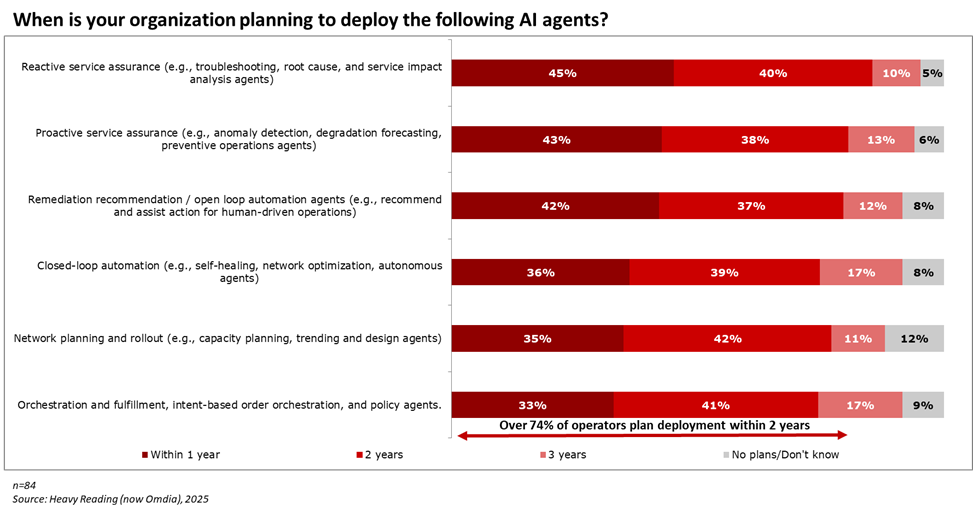
The goal is autonomous operations, aligned with TM Forum’s Autonomous Networks vision of closed-loop automation across services and domains. Getting there requires a phased approach. And the bridge is what we call Hybrid Operations, where humans and AI work as colleagues, combining their complementary strengths.
How Hybrid Operations work
Hybrid Operations combine two complementary models that fundamentally shift how CSPs manage their networks.
The first is hybrid cognition, where AI analyzes massive volumes of alarms, logs, tickets, and performance data to deliver fast root cause diagnosis and impact analysis. Agents recommend actions based on standard operating procedures. Humans then review these recommendations and make the final decisions. Known as the Human-in-the-Loop (HITL) approach, it preserves human judgment for complex situations while letting AI handle the analytical heavy lifting, building trust in AI recommendations and accelerating adoption.
The second is hybrid workforce. CSPs deploy a digital workforce of specialized AI agents that work autonomously, collaborating with humans who intervene only for edge cases or situations requiring deeper context. Known as the Human-on-the-Loop (HOTL) approach, it transforms the human role from executing tasks to orchestrating and supervising agents, acting as the safety net when exceptions arise.
From strategy to execution
Going forward, CSPs face a clear choice: continue with tactical AI for incremental gains or commit to an operating model that makes cognitive operations possible.
Ultimately, becoming a Cognitive Telco means three things. First, deploying AI purpose-built for telecom, including models and agents trained on telco data, integrated via open standards, and validated through network digital twins. Second, starting where the business case is proven, using service assurance to deliver measurable ROI through hybrid operations that combine AI efficiency with human oversight. And third, measuring what matters, including tracking TM Forum’s Key Effectiveness Indicators (KEIs) such as mean time to repair, SLA compliance ratio, service availability, and then scaling based on outcomes.
Few CSPs have the verticalized AI platforms, domain expertise, and integration capabilities required to realize this vision alone. Amdocs, working with AWS, Azure, Google, and NVIDIA, helps CSPs make this shift safely and at scale.
Discover how Amdocs Autonomous Network Operations powered by aOS, accelerates your journey HERE.

Autonomous Network Operations
AI agents execute work end-to-end across network domains – delivering services, resolving issues, optimizing performance, and managing capacity autonomously.

Agentic Operations
The aOS execution layer for agentic telco-grade workflows across business and network operations.