The Agentic Shift: Architecting the Sovereign Telco with Amdocs aOS and NVIDIA
The telecommunications industry has moved past the "Chatbot Era." While early Generative AI pilots focused on simple text retrieval, the true challenge for CSPs lies in autonomous execution-the ability for AI to not just suggest an answer, but to navigate complex BSS/OSS environments, perform multi-step reasoning, and resolve issues end-to-end.
At the center of this transformation is Amdocs aOS (Agentic Operating System for telco), that enables service providers to become AI-embedded enterprises. Integrated with NVIDIA, aOS represents a fundamental shift in telco software architecture.
The Foundation: aOS and the Cognitive Core
Amdocs aOS is not a single application; it is an operating system that sits atop any existing BSS, OSS, or network stack. Its mission is to embed intelligence directly into the operational fabric of a telco.
At the center of aOS sits the Cognitive Core, a telco-trained agentic foundation with domain-specific agents, sub-agents, real-time decision intelligence, and policy guardrails required for enterprise-grade safety. By utilizing NVIDIA’s high-performance infrastructure, Cognitive Core can process billions of daily transactions while maintaining the low-latency response times required for real-time customer engagement.
The Strategic Imperative of Open-Source Models
A critical design choice in the development of aOS was the prioritization of open-source, open-weight models. For global telco, "closed" frontier models behind proprietary APIs present three significant risks:
- Data Sovereignty: Telco data is subject to strict regional regulations (such as GDPR or local telecommunications acts). Sending this data to a third-party black-box model is often a compliance non-starter.
- Vendor Lock-in: Relying on a single proprietary provider creates long-term strategic fragility.
- Cost Scaling: At telco volumes, the cost-per-token of proprietary frontier models can quickly become prohibitive.
By leveraging open-source models, Amdocs enables telcos to run their "AI Brain" within their own Telco AI Workflows-on-premise or in sovereign clouds-ensuring that sensitive subscriber data never leaves their controlled perimeter.
Within the Cognitive Core, Amdocs found that the NVIDIA Nemotron-3 Super 120B is an excellent candidate model for aOS agentic workflow. Nemotron-3 Super is a hybrid Mixture-of-Experts (MoE) model that utilizes a breakthrough Mamba-Transformer architecture.
Why Nemotron-3 Super?
- Efficiency: Its MoE design means that while it has 120B total parameters, only a fraction (approx. 12B) are activated per token. This delivers the reasoning power of a massive model with the speed and throughput of a much smaller one.
- Native 4-bit Precision: Trained natively in NVFP4 on NVIDIA Blackwell architecture, it maintains state-of-the-art accuracy while significantly reducing the memory footprint.
- Agentic Native: Unlike general-purpose LLMs, Nemotron-3 was specifically post-trained using multi-environment reinforcement learning to excel at tool-calling, multi-step planning, and instruction following.
The open-source nature of Nemotron-3 allows Amdocs to treat the model as a transparent, portable component. Because the weights, training recipes, and even the synthetic data used for alignment are open, Amdocs can verify the model’s behavior and package it as a "guaranteed safe" element within the aOS Cognitive Core.
This portability means a CSP can start a project in a development environment and migrate the entire agentic stack-including the model-to a high-security production data center without rewriting a single line of orchestration code.
In the aOS architecture, no single model is a silver bullet. Nemotron-3 Super anchors the middle-to-high-tier of this anthology. With its 1-million-token context window, it allows aOS agents to "remember" massive amounts of technical documentation, entire customer billing histories, and complex network topologies in a single reasoning pass. This eliminates the need for fragmented "chunking" in RAG (Retrieval-Augmented Generation) systems, which often leads to lost context and hallucinations.
Technical Deep Dive: Benchmarking LLMs in Cognitive Core Agentic Telco Scenarios
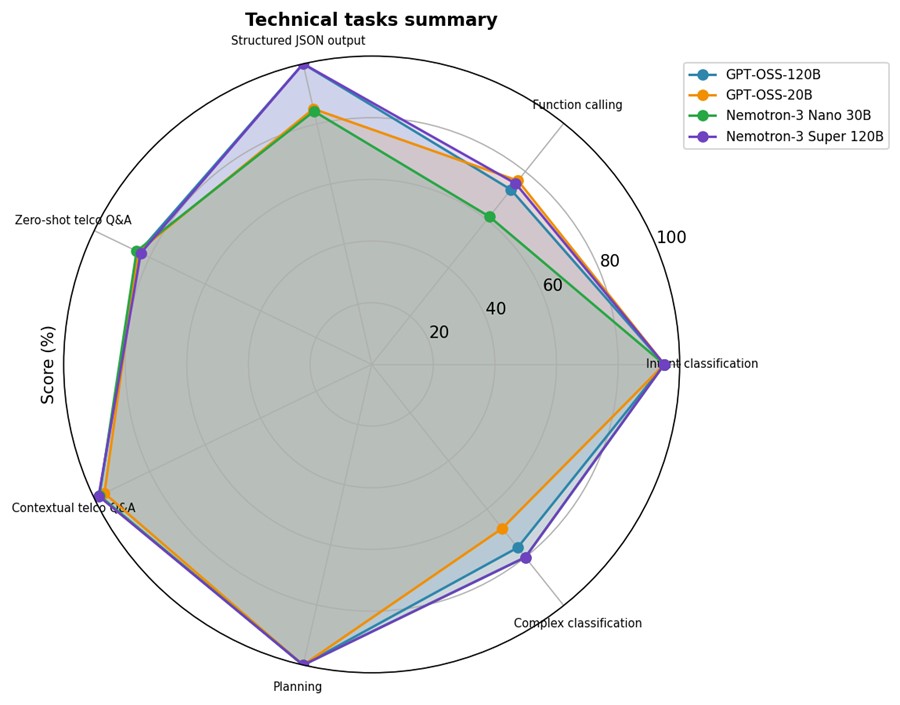
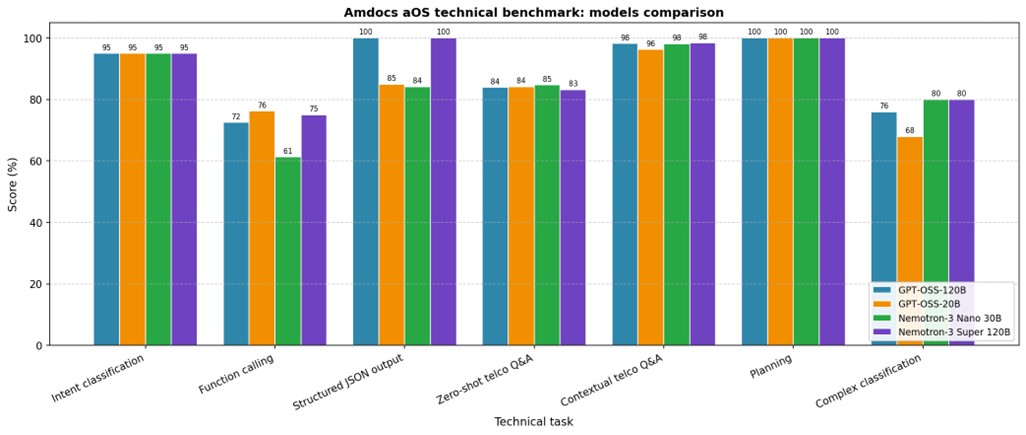
Amdocs evaluated NVIDIA Nemotron3 Super 120B across production-pattern telecom workloads that mirror Cognitive Core agents’ behavior, including but not only: structured generation, complex classification, zero-shot reasoning, contextual Q&A, planning-style reasoning, and intent understanding. The evaluations use real telco prompts and strict schema/format checks to reflect downstream automation needs in Cognitive Core multiagent orchestration.
We compared NVIDIA Nemotron3 Super 120B and NVIDIA Nemotron-3 Nano 30B with OpenAI’s GPT-OSS (20b and 120b), since all of them represent a shift toward agentic reasoning and hardware‑optimized efficiency in the open‑source landscape. Both NVIDIA families use a Mixture‑of‑Experts (MoE) architecture, making the comparison particularly relevant.
Where Nemotron3 Super 120B Leads
- Complex classification (overall avg. score: ~80%): In scenarios that required both correct labeling and correctly formatted, multi field outputs, Super achieved the highest overall avg. score for stability and format discipline-key for downstream tool calls and workflow routing.
Where Nemotron 3 Super 120B Matched the Best
- Structured JSON output (overall avg. score: ~99%): Super delivered the most consistent, schema aligned structured generation-tables, cards, and carousels-maintaining execution reliability across nested layouts and longer outputs. This translated into the top overall avg. score for structured output suitability in agentic pipelines.
- Contextual telco Q&A (overall avg. score ~99%): Policy aligned, terminology correct answers across billing, usage, fees, and adjustments; Super tied for the top overall avg. score on billing and sales agent contextual telco reasoning.
- Planning style reasoning (overall avg. score ~99%): Consistent multistep responses with reliable parameter extraction and action ready structure; Super matched the highest overall avg. score in planning suitability for multi-agent flows.
- Intent classification (overall avg. score: ~95%): Production grade routing quality with stable precision/recall and strict format compliance; Super matched the top overall avg. score on intent understanding.
- Zero shot telco Q&A (overall avg. score: ~85%): Strong semantic alignment and robust handling of previously unseen phrasing; Super tied for the top overall avg. score.
Bottom line
Across the agentic task set, Nemotron3 Super 120B led on tasks where reasoning and following structure is critical (complex classification) and matched the top overall average scores on all other tasks; structured JSON, zero shot reasoning, contextual Q&A, planning, and intent classification-making it an excellent candidate model for agentic workflows in Amdocs Cognitive Core.
Latency Overview (Nemotron 3 Super 120B)
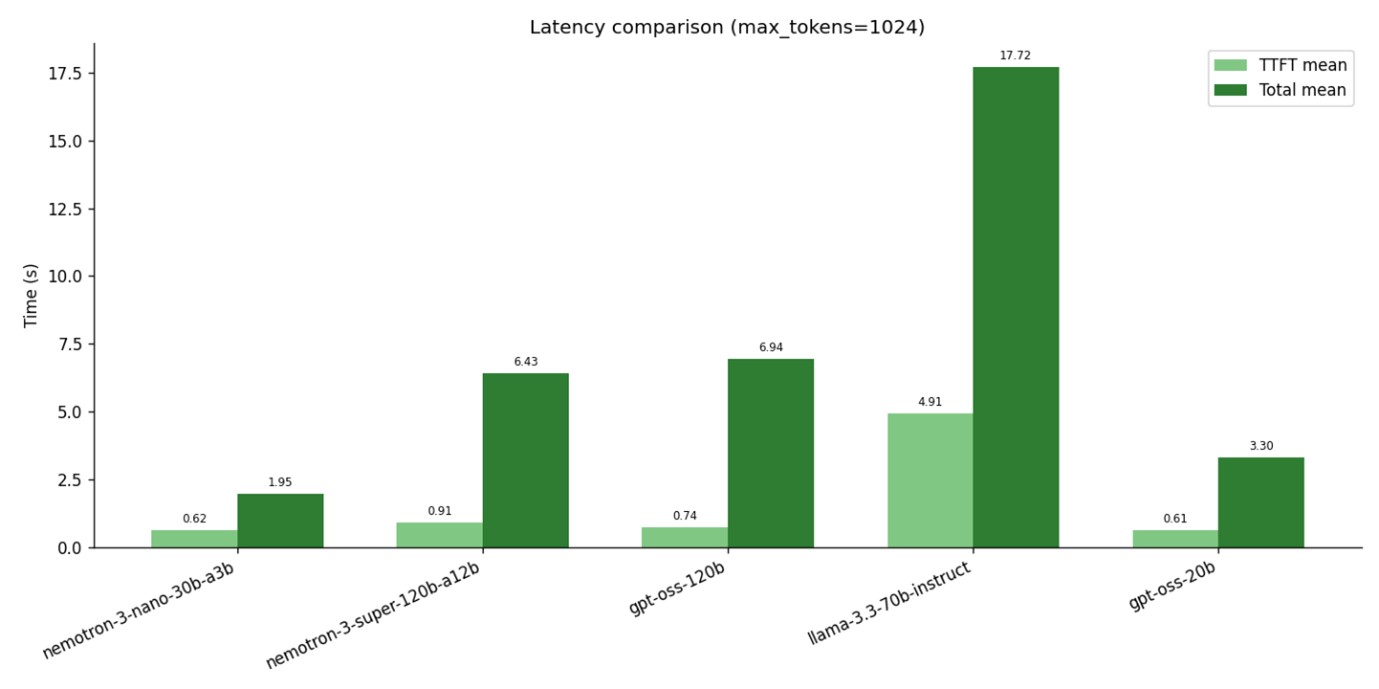
Across the latency evaluation, Nemotron3 Super 120B demonstrated solid generation times, balancing high quality reasoning and structured output with a latency profile suitable for Cognitive Core agentic workflows. We focused on agentic tasks that require long context understanding and may be a latency bottleneck for real-time customer service applications. While not always the fastest model in the benchmark, Super 120B remained within the mid-range latency band, consistently outperforming larger context instruct models while matching close to the latency of similar sized competitors.
(Note: latency was tested on a regular development environment, for all endpoints, without any special optimizations)
The Agentic Workflow: NVIDIA AIQ and Deep Research
Amdocs Cognitive Core delivers agentic components designed to tackle specific telecom challenges such as bill analysis and sales assistance. These agentic components are powered by intelligent AI agents that autonomously handle tasks, streamlining complex processes. By connecting these agents into seamless, autonomous, AI-driven workflows, Amdocs transforms traditionally manual and fragmented telecom operations into efficient, integrated solutions.
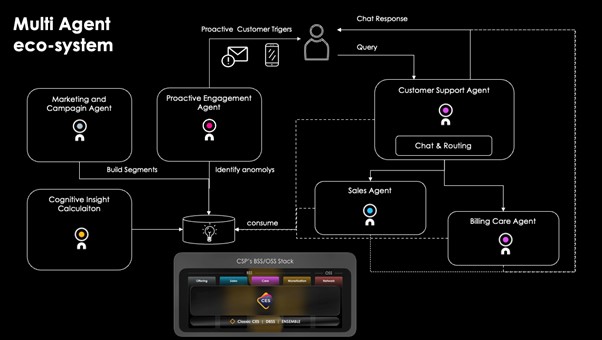
For agentic workflows and components to succeed, several essential features must be enabled:
- Hierarchical Task Planning: Agents can break down a single customer request into multiple sub-tasks, delegating responsibilities across the ecosystem. This ensures clear separation of concern and accountability.
- Self-Reflection: At each step, agents validate their actions against telco policy guardrails, which reduces errors by up to 40% in complex workflows.
- Human-in-the-Loop: Agents operate safely with controlled decision-making, requiring human oversight for clarifications and approvals. This method enables agents to request assistance or escalate issues when needed.
- Unified Agent Observability: When a task is assigned to an agent, a full workflow may be executed autonomously. Every decision and outcome is tracked within the context of execution for future improvements and debugging.
To enable these capabilities and more, the Amdocs Cognitive Core architecture combines multiple software solutions into a cohesive platform.
LangChain and LangGraph are central to agent orchestration, supporting agent construction, memory management, parallel execution, human-in-the-loop processes, and interruption handling. Their abstractions for different agent architectures—such as ReACT, ambient, and deep search—are integrated into the solution.
The Nvidia NeMo Agent Toolkit is an open-source framework for building and optimizing AI agents. It offers unified monitoring, debugging, and performance tuning across teams of AI agents. This toolkit is pivotal in the Amdocs Cognitive Core ecosystem, simplifying the development and orchestration of complex agent workflows.
The Model Context Protocol (MCP) provides agents with access to BSS/OSS telecom data sources via a comprehensive Telco-specific ontology layer. This semantic layer is self-describing, discoverable, type-safe, and consolidated across various telecom business domains.
The Agent-to-Agent (A2A) protocol ensures a unified approach for discovering and initializing agent tasks during workflow orchestration, delivering clarity and governance.
NVIDIA AIQ-2 and the Deep Research Blueprint offer a robust, production-ready framework for designing, optimizing, and assessing agent-driven AI research workflows. These tools empower enterprises to quickly generate large-scale, citation-supported insights and provide a foundational toolkit for uncovering operational patterns, establishing control points, and managing infrastructure. For example, it powers Proactive Engagement agents. Unlike conventional reactive systems that only respond after a customer complaint, the NVIDIA AIQ-2 and Deep Research Blueprint enable the Cognitive Core to operate continuously in the background. This allows it to analyze millions of customer interactions and billing records, detect emerging issues—such as missed discounts or impending contract expirations—and generate solutions before the customer becomes aware of the problem.
Conclusion: Driving Innovation and Flexibility
The partnership between Amdocs and NVIDIA is built on a shared commitment to openness and flexibility. By combining Amdocs’ deep domain expertise in telecom with NVIDIA’s cutting-edge AI research and Blackwell-generation hardware, we are providing the industry with a roadmap for the future.
Together, we are ensuring that the next generation of telco operations is not just "AI-assisted," but Agentic by Design-sovereign, scalable, and built on the most performant open-source foundations available today.