

Primary mainframe modernization strategies
Built on the FastTrack Migration Factory and Amdocs Studios’ digital transformation practices, Amdocs’ end-to-end mainframe transformation solution delivers a seamless, low-risk, and cost-optimized modernization journey—from legacy operations to cloud-native deployment and ongoing optimization.
By modernizing legacy applications you can achieve up to
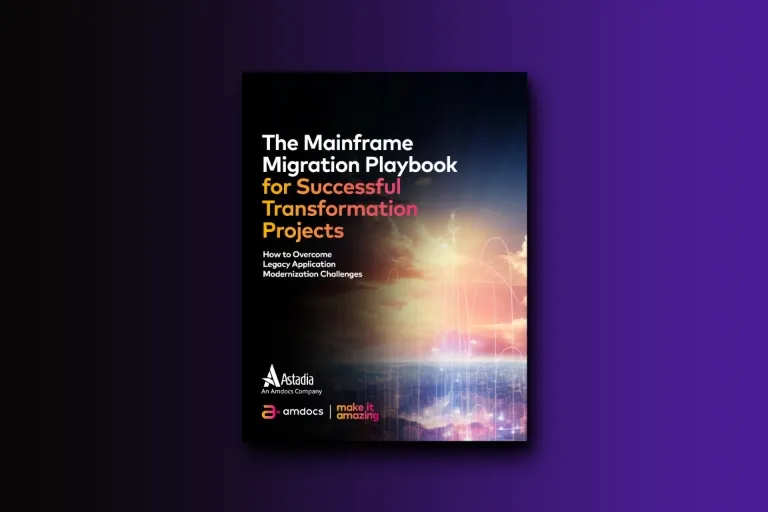
The mainframe migration playbook
Explore the most frequent questions about legacy applications modernization including the answers and solutions implemented in 300+ successful projects.
Useful Resources
Whitepaper: An Agentic AI Approach to Rearchitecting for the Cloud
How Amdocs’ mainframe modernization experts facilitate digital growth, using agentic AI for a quicker, cheaper, and safer transition to microservices.
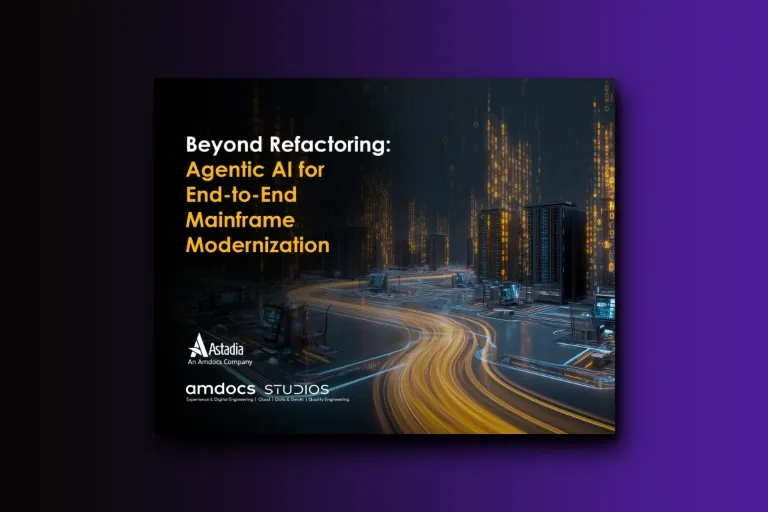
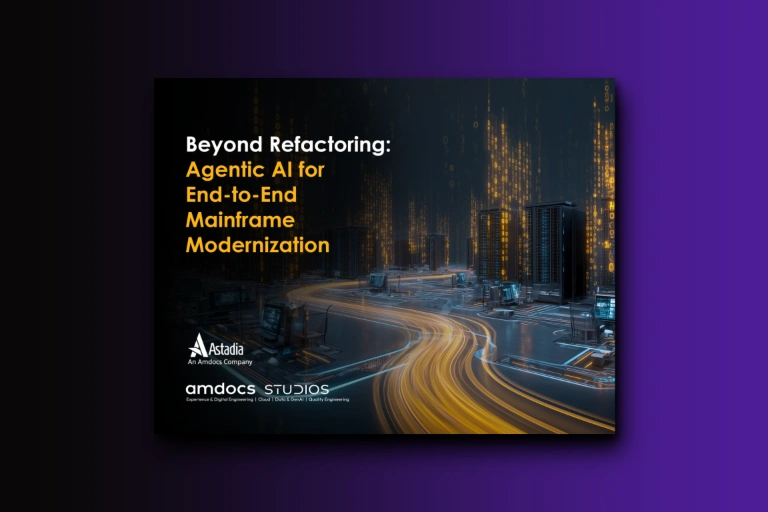
Beyond Refactoring: Agentic AI for End-to-End Mainframe Modernization
Modernize with precision and purpose, combining automated refactoring and AI-driven re-architecting to unlock true business transformation.
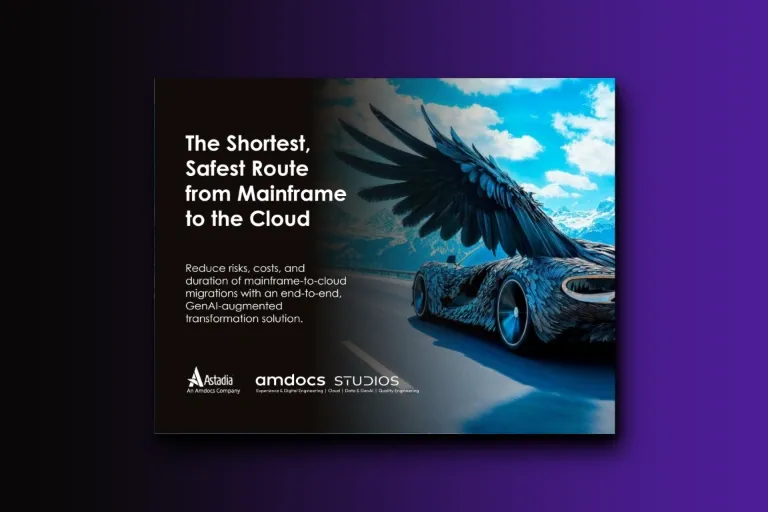
Brochure: The Shortest, Safest Route from Mainframe to the Cloud
Reduce risks, costs, and duration of mainframe-to-cloud migrations with Astadia’s FastTrack Factory
Whitepaper: The Industrialization of Mainframe-to-Cloud Migration
Curious what makes our FastTrack modernization solution unique? Download the white paper to learn more about the software tools and automated processes it entails.
Whitepaper: The FastTrack Mainframe Migration Process
A fully automated and efficient pathway to streamline the process of mainframe transformation, enhancing agility and reducing operational costs of your IT environment.
Whitepaper: Mainframe Modernization: A Guide to Calculating ROI
This guide provides the strategic insights necessary to gather critical data, thoroughly assess return on investment, and develop a compelling, well-founded business case for investment.

Modernization: Laying the groundwork for digital transformation
Mainframe modernization offers opportunities to clear roadblocks and re-engineer legacy processes, allowing organizations to keep up with the demands of the digital economy.
FastTrack your mainframe to cloud journey
Learn how Astadia’s FastTrack solution can help you streamline complex software transformations.
Use Cases

Rearchitect to Cloud with GenAI
Modernizing the Mainframe: Transformation Intelligence for Next-gen Applications

Modernize CA IDMS Applications with Confidence
IDMS (Integrated Data Management System) by Broadcom has long been a cornerstone for IBM z Systems, delivering business value for hundreds of enterprises and government organizations around the world.
Scale your business with value-led modernization
Leverage our advanced AI-driven and automated tool to ensure focused modernization efforts and maximum value extraction.

Banking modernization begins with mainframes
Achieve up to 90% savings on operating costs through fully automated modernization.
Customer References

Deutsche Asset Management Achieves $7 million Annual savings with Mainframe Modernization
Astadia migrates application portfolio from z/VSE & Adabas-Natural to .NET.
A success story from Astadia, an Amdocs company.

Foyer Group Modernizes Legacy Systems, Achieves Enhanced Agility and Cost Efficiency with Astadia
Astadia refactors Foyer’s COBOL and EGL based legacy to Linus and Java based modern platform.

Société Générale Luxembourg Transforms Core Banking Systems with Cloud Migration by Astadia
Astadia moves core banking systems to the private cloud for Société Générale Bank and Trust.
Related Insights







Frequently Asked Questions
Mainframe modernization is a business-critical transformation that goes beyond code conversion or infrastructure move. Explore answers to common questions about mainframe to cloud migration, COBOL modernization, automated refactoring, agentic AI, data migration, testing and rearchitecting legacy applications as cloud-native microservices.
What is mainframe modernization?
Mainframe modernization is the process of transforming legacy applications, data, infrastructure, integrations and delivery practices to improve business agility, reduce operational risk and enable innovation. It may involve modernizing applications on the mainframe, integrating them with cloud services, or migrating workloads from platforms such as IBM z/OS or z/VSE to cloud or distributed environments.
Why are enterprises modernizing mainframe applications?
Enterprises pursue mainframe modernization to increase speed to market, control operating costs, address scarce legacy skills and make core business capabilities easier to integrate with cloud, data and AI services. Modernization can also improve development productivity, scalability, security, resilience and access to business-critical data.
Is mainframe modernization the same as mainframe migration?
No. Mainframe migration changes where an application or workload runs; mainframe modernization changes how it is built, operated, integrated or evolved. A mainframe to cloud migration may rehost or replatform an application with limited functional change. A deeper modernization may refactor legacy code into Java or C#, redesign data and interfaces, introduce APIs and DevSecOps, or rearchitect a monolith into cloud-native microservices. Migration and modernization can happen together or in stages. The best sequence depends on business priorities, application dependencies, time constraints and the target operating model.
How do you choose the right modernization approach for each workload?
Start with an application and portfolio assessment that maps business value, technical complexity, cost, risk, dependencies, data, transaction volumes and change demand. The assessment should identify which applications can be retired or replaced, which need a lower-change migration path, and which justify deeper refactoring or rearchitecting. Decision criteria should include required time to value, functional differentiation, cloud readiness, code and data quality, integration complexity, performance and availability requirements, regulatory constraints, team skills and acceptable change risk.
How does a mainframe to cloud migration work?
A mainframe to cloud migration typically moves through seven stages: discovery, dependency analysis, target architecture, transformation, data migration, testing and cutover. Teams first inventory application code, databases, files, batch jobs, transaction flows and external interfaces. They then select an appropriate migration pattern and target environment, such as AWS, Microsoft Azure, Google Cloud, a private cloud or a hybrid architecture.
Can applications running on IBM z/OS and z/VSE be modernized?
Yes. Applications running on IBM z/OS and IBM z/VSE can be modernized in place, integrated with cloud services or migrated to modern cloud and distributed platforms. The scope may include COBOL, Assembler, Natural, JCL and batch workloads, together with databases, files, transaction processing, security controls and interfaces. Because z/OS and z/VSE portfolios often contain decades of interconnected business logic, the first priority is accurate discovery. Dependency mapping helps determine the correct application boundaries, migration sequence and target architecture while reducing the risk of overlooking shared data, utilities or upstream and downstream systems.
Can COBOL applications be converted to Java or C#?
Yes. COBOL modernization can convert suitable mainframe applications to Java or C# while preserving the business rules and behavior embedded in the legacy system. A robust COBOL-to-Java or COBOL-to-C# transformation covers more than syntax: it must address copybooks, JCL and batch processes, data access, transactions, error handling, integrations and the target runtime.
What does IDMS modernization involve?
IDMS modernization typically involves three interdependent workstreams: application code conversion, database migration and replacement of the online transaction and interface capabilities associated with IDMS/DC. Depending on the source application, this can include COBOL/DML programs, ADS/O dialogs, schema and subschema definitions, network-model data, batch processing and integrations.
How can Adabas and Natural applications be modernized?
Adabas and Natural modernization transforms Natural application logic, Adabas data structures, batch processes and interfaces for a modern target environment. Depending on business goals, Natural programs may be converted to Java or C#, while Adabas data is migrated to a relational or cloud database. The program should account for online transactions, Natural subprograms, utilities, scheduling, security, external integrations and data semantics, not only source-code conversion.
What is the difference between refactoring and rearchitecting mainframe applications?
Refactoring mainframe applications changes the codebase and target technology while largely preserving existing functionality and application boundaries. For example, automated refactoring may convert COBOL or Natural to Java or C# and migrate legacy data stores to modern databases. This approach can accelerate platform exit while limiting business change. Rearchitecting makes a deeper structural change. It analyzes business capabilities and dependencies, decomposes a monolithic application and creates a new architecture based on APIs, domain services and microservices. Rearchitecting can deliver greater long-term agility and cloud-native scalability, but it requires more design decisions and validation. A combined strategy can refactor some workloads for speed while rearchitecting the capabilities that create the most business value.
Transform Smarter. Deploy Faster.
Ask us how.
Transform Smarter. Deploy Faster.
Ask us how.